
AI voice agents for telecom understand, resolve, and personalize calls at scale. Here is how they are transforming customer service, cost, and speed in 2026.
Not long ago, a telecom call meant a long menu and a longer wait. Today, something different answers. It greets you by name. It understands your problem in plain words. Then it fixes it in seconds, at 2 a.m., in your language. This is the AI voice agent, and it is reshaping telecom support fast. In 2026, telecom leads every industry in AI adoption. So the question is no longer whether AI voice agents for telecom matter. It is how much they can transform your customer service. Let us break it down.
The Real Problem: Old Telecom Support Cannot Scale
Telecom support faces a hard math problem. Call volumes are huge. Costs keep rising. And customers expect instant help, day or night. The old model simply cannot keep up. Here is where it breaks down:
- Long wait times. Customers hang up; about 75% have quit a call after being kept on hold.
- High cost per call. A human call costs $7 to $12, and volume makes that painful.
- 24/7 demand. People want help at midnight, not just from 9 to 5.
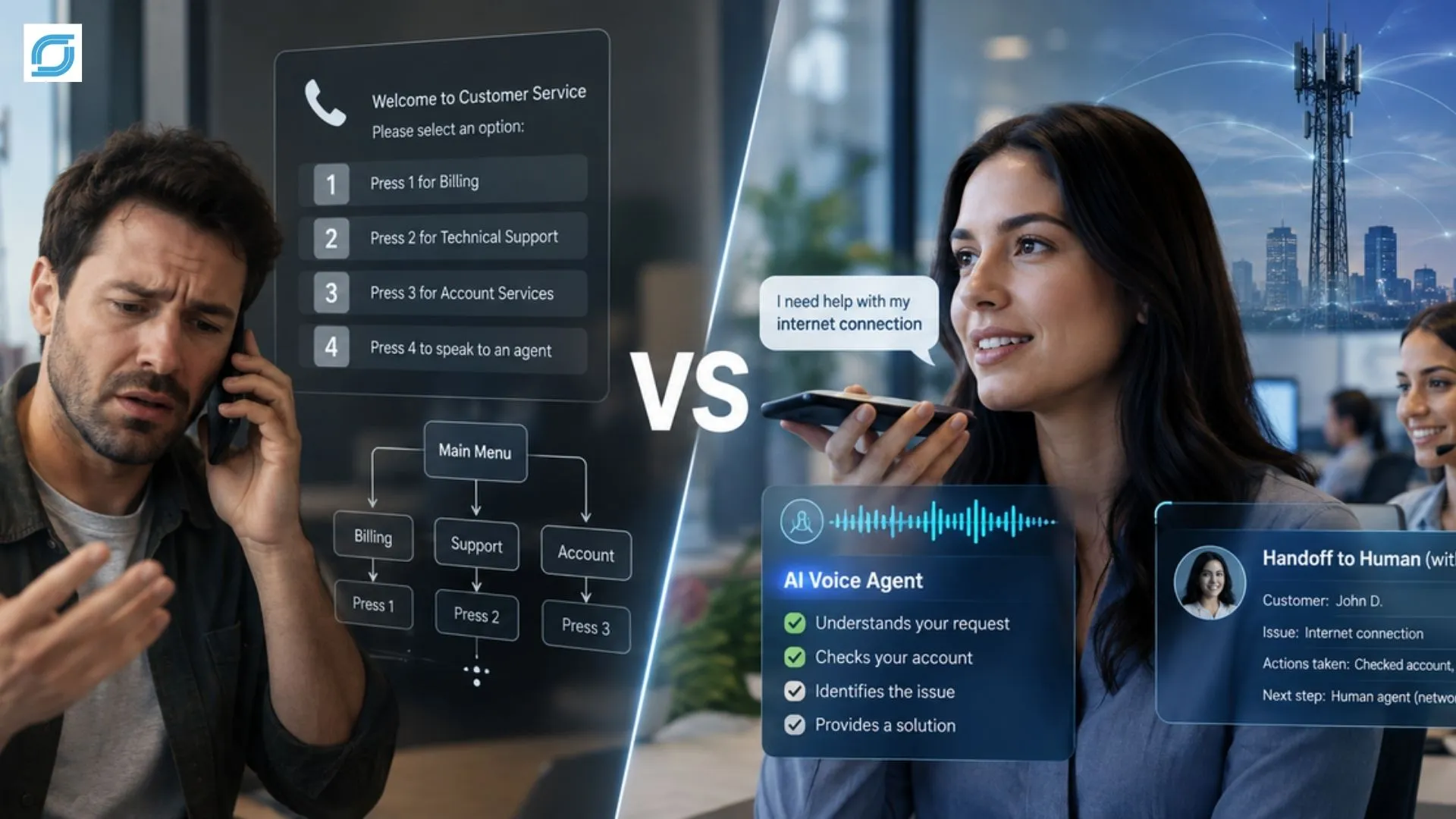
- IVR frustration. Rigid menus send customers in circles.
- Agent burnout. Repetitive calls drive turnover and cost.
- Language gaps. Global bases need many languages at once.
Each gap hurts CX and margin. Worse, a slow call sends customers to a rival; about 79% will switch for a faster response. That is the gap AI voice agents fill.
What Makes an AI Voice Agent Different
An AI voice agent is not an old phone menu. It is built on generative AI and natural language processing. So it understands what a caller means, not just what they press. Then it speaks back in a natural voice. It also connects to your billing and network systems. So it can actually complete tasks, not just route them. In short, it listens, understands, acts, and resolves. It also learns over time, so it gets better with every call. That is the heart of AI-powered telecom customer service. And unlike a human team, it never sleeps and never gets tired.
How AI Voice Agents Transform Telecom Customer Service
So how do AI voice agents change telecom support? Six shifts stand out.
I. Instant, 24/7 resolution: The agent answers on the first ring, any hour. No hold music, no queue. Routine issues get solved right away.
II. Natural conversation: Callers speak plainly. The agent follows, even when they change topic. So there is no menu maze.
III. Personalization: The agent knows the account. It sees the plan, the balance, and the recent history. So the help feels tailored, not generic.
IV. Proactive outreach: AI voice agents also call out. They warn of outages, confirm renewals, and handle gentle payment reminders. So problems get solved before they grow. In fact, one proactive call can prevent many angry inbound ones.
V. Multilingual service. One agent handles many languages and switches mid-call. So global subscribers get help in their own words.
VI. Agent augmentation: The AI handles routine volume. Then it passes complex calls to humans, with full context. So your people focus on high-value work, like retention and complex fixes.
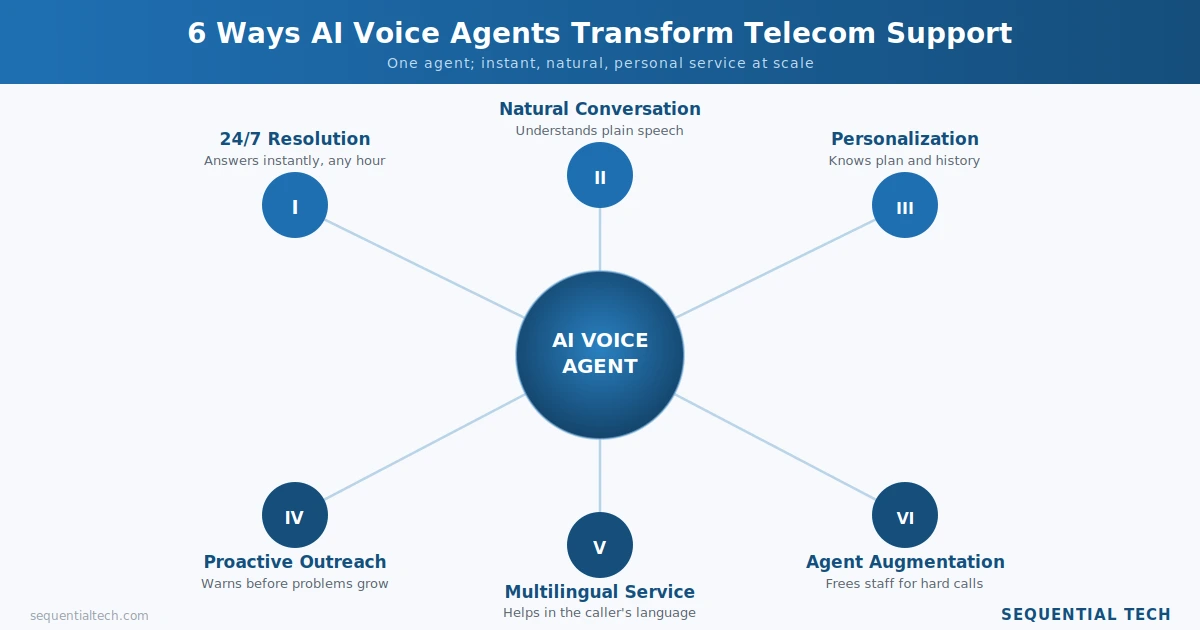 Six ways AI voice agents are transforming telecom customer service in 2026.
AI Voice Agents in Action: Telecom Use Cases
Where do AI voice agents help most in telecom? The table below shows the top use cases.
| Telecom Task | What the AI Voice Agent Does | Impact |
|---|---|---|
| Billing and payments | Explains charges, takes payments, sets up autopay | Fewer billing calls to humans |
| Plan changes | Compares plans, upgrades or downgrades on the call | Faster self-service and upsell |
| Activation and SIM | Guides SIM setup and activation steps | Smoother onboarding |
| Outage status | Confirms outages and gives live updates | Fewer repeat calls |
| Roaming setup | Turns on roaming and explains rates | Less bill-shock frustration |
| PIN or password reset | Verifies and resets securely | Instant, 24/7 fix |
| Appointment booking | Schedules or reschedules installs | Fewer missed slots |
What the 2026 Data Shows
The numbers show how fast this is moving. Here is where telecom sits today:
- Telecom leads adoption. Telecom now tops every industry, with about 95% using AI in support.
- Voice AI is scaling. Voice AI handles 19% of inbound calls in 2026, up from 6% in 2024. Telecom leads that rise.
- Volumes drop. In one gen-AI telecom program, call volume fell about 30% and handle time by more than a quarter.
- Costs fall. A voice-AI resolution costs about $1.18, versus $7.40 for a human. That is roughly a 90% cut.
- Resolution rises. First-call resolution climbs from about 65% to 85% or 95%.
- Trust grows. 62% of consumers are now comfortable with AI voice for routine tasks, up from 41% in 2024.
Clearly, AI voice agents are no longer a test. They are a core part of telecom CX.
How to Roll Out AI Voice Agents
You do not flip a switch overnight. Instead, start small and scale. This keeps risk low and trust high. A simple path works best:
- Pick high-volume intents. Start with balance checks, outages, or resets.
- Connect your systems. Link billing, CRM, and provisioning first.
- Run a pilot. Test on real calls, with a human safety net.
- Measure results. Track resolution, CSAT, and cost.
- Scale what works. Add more intents as the numbers hold.
Most telecom deployments go live in two to four weeks. So value comes fast, without a risky “big bang” switch. Then you expand with confidence, one intent at a time.
What This Means for Telecom Operators
For a telecom leader, the message is simple. AI voice agents cut cost and lift CX at the same time. They absorb routine volume, so wait times fall. They free your agents for the calls that need a human. And they scale across languages and time zones.
But the tool must fit telecom. It needs to connect to your billing and network systems. It must also escalate cleanly to a human when a call gets complex. So choose a partner who knows telecom, not a generic bot. The right partner tunes the agent to telecom terms, rules, and workflows. That fit is what turns a good demo into real results.
Give Every Caller an Instant Answer
The telecom call has changed for good. Customers now expect fast, natural, 24/7 help. AI voice agents deliver exactly that, and they cut cost while they do it. So the question is not whether to adopt. It is how fast you can start.
Stop Making Customers Wait on Hold
Sequential Tech, a Fusion CX company, deploys an AI Voice Agent for telecom that understands natural speech, resolves up to 78% of calls, and speaks 15+ languages, alongside customer care and technical support, live in two to four weeks.