Manual telecom call monitoring reviews only a few percent of calls. Here is why automated, AI-powered monitoring is essential for telecom contact centers and BPOs.
Imagine judging a basketball player’s whole season by watching 2% of their shots. That is how most telecom contact centers still run quality. They review five or ten calls per agent each month. Meanwhile, thousands of other calls go unheard. That angry customer who hung up? The compliance slip at 2 a.m.? Nobody caught them. For years, manual call monitoring was the only option. In 2026, it no longer works. This is why telecom call monitoring must move from spot-checks to full coverage.
The Real Problem: You Only See a Sliver
Manual QA has one fatal flaw. It only samples. A human reviewer can check just 1% to 5% of calls. On average, only about 3% get reviewed at all. So most of your customer conversations are never scored. Here is what that blind spot hides:
- Compliance breaches on calls no one heard.
- Angry customers who churn without a trace.
- Coaching moments that never reach the agent.
- Fraud signals that slip past unseen.
- Sales misses from an off day nobody flagged.
In telecom, calls touch billing, activations, and outages. So each missed call is a real risk. The sample simply cannot protect you. And in telecom, the sheer volume only makes the gap wider.
Why Manual Call Monitoring Breaks Down
The problem is not effort. It is math. Manual monitoring breaks down in four ways.
I. Coverage. A team reviewing four calls per agent a month sees about 1% of the work. You cannot fix what you cannot see.
II. Consistency. Two reviewers score the same call differently. So your data is noisy and hard to trust.
III. Timing. Manual reviews arrive days or weeks late. By then, the agent has repeated the mistake many times.
IV. Cost and scale. Each manual review takes 20 to 30 minutes. As call volume grows, that cost climbs fast. Yet coverage still stays tiny. In short, more effort does not fix the math. Only automation does.
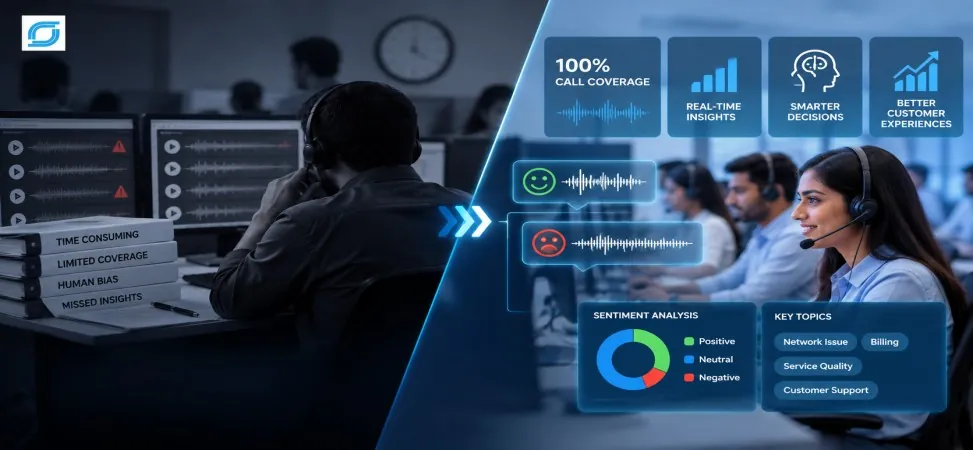
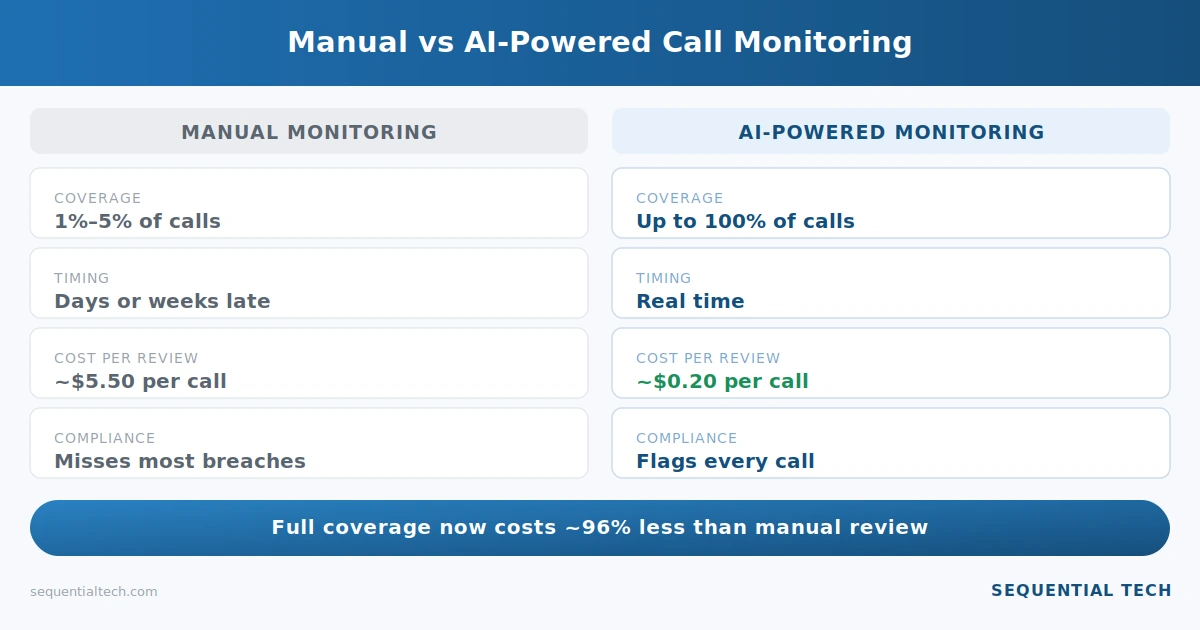 Manual vs AI-powered call monitoring: coverage, cost, and compliance.
The Hidden Costs of Manual Monitoring
A small sample feels cheap. In truth, it is expensive. The costs just hide in other places:
- Compliance exposure. A 2% sample has a 98% chance of missing any single breach on a given day. Penalties are steep. HIPAA fines reach $50,000 per incident, and PCI slips can risk your card processing.
- Customer churn. Frustrated customers leave, and you never learn why.
- Weak coaching. Agents get feedback on a few calls, not their real performance.
- Agent turnover. Vague, random feedback frustrates your best people.
- Statistical noise. You need over 1,000 calls for real confidence. A handful proves nothing.
These hidden costs add up. They quietly drain quality, compliance, and margin.
Manual vs Automated Call Monitoring: Side by Side
The gap is clear when you compare the two directly.
| Factor | Manual Call Monitoring | Automated / AI-Powered Monitoring |
|---|---|---|
| Coverage | 1% to 5% of calls | Up to 100% of calls |
| Timing | Days or weeks later | Real time |
| Consistency | Varies by reviewer | Uniform scoring |
| Compliance | Misses most breaches | Flags PCI, consent, disclosures |
| Cost per review | ~$5.50 per call | ~$0.20 per call |
| Coaching | Occasional | Continuous and evidence-based |
| Channels | Voice, one at a time | Voice, chat, email, social |
What AI-Powered Call Monitoring Changes
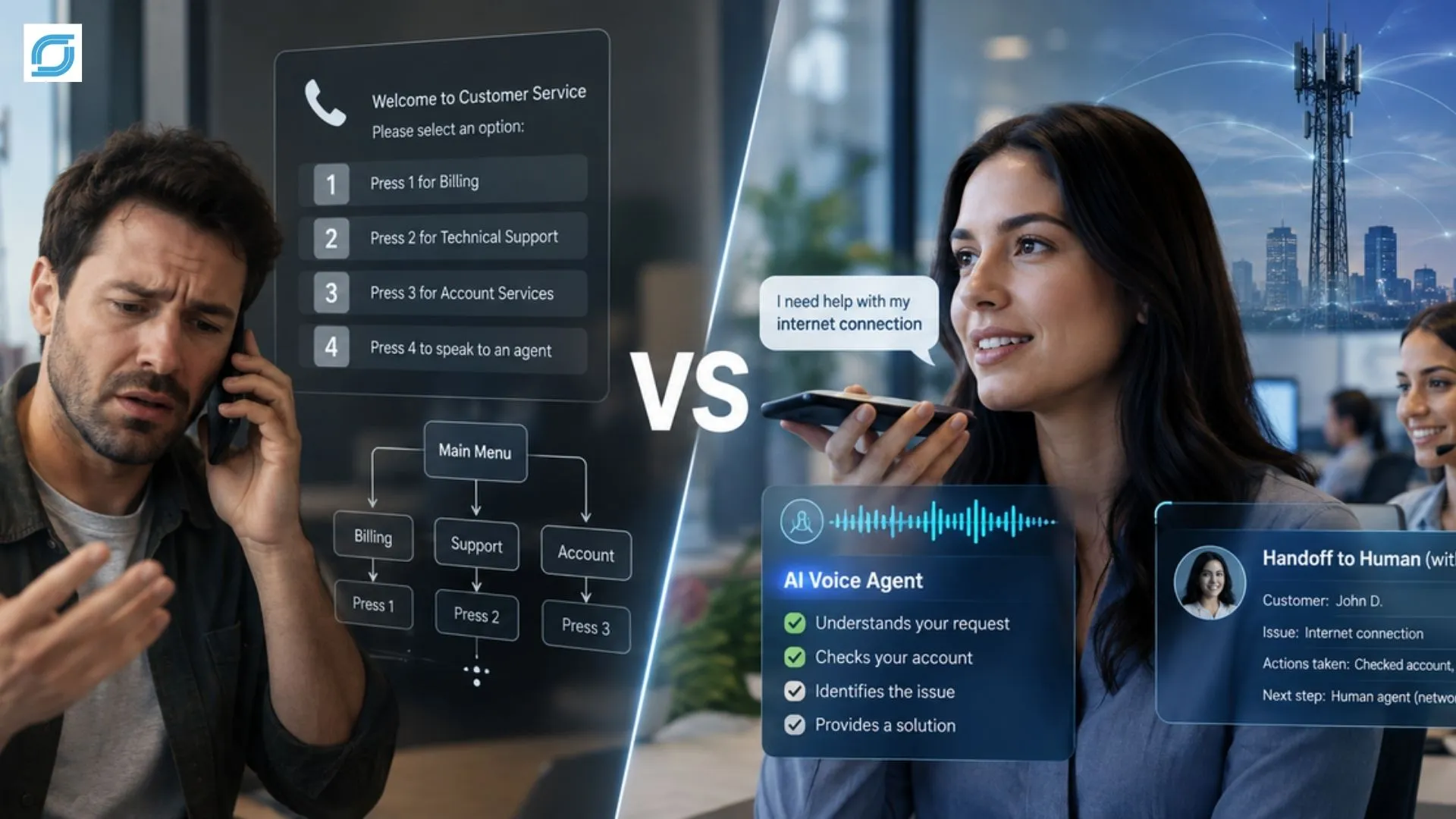
Automated call monitoring flips the model. Instead of sampling, it scores every interaction. It listens to 100% of calls in real time. Then it grades compliance, tone, and accuracy on all of them. It also reads sentiment. So it flags a frustrated customer even when they never say “I’m upset.”
The cost math changes too. AI review runs about $0.20 per interaction. A human review costs about $5.50. That is a 96% drop, with full coverage instead of a sample. This is the core of modern telecom contact center quality management. You can explore the full AI solutions suite to see how it fits together.
The 2025–2026 Data Telecom Leaders Should Know
The shift is measurable. Here is where the numbers sit today:
- Coverage gap. Manual QA reviews 1% to 5% of calls. AI scores up to 100%.
- Cost. AI review costs about $0.20 per call, versus $5.50 by hand — a 96% cut.
- Results. Analyzing 100% of calls lifts CSAT by about 10% and cuts costs 20% to 30%, per McKinsey.
- Adoption. By 2025, about 80% of service teams use some form of AI.
- Fraud. AI-driven fraud losses may hit $40 billion by 2027, and much of it moves through the call channel.
- Speed. Automated tools surface coaching moments in hours, not weeks.
The message is simple. Full coverage is now both possible and affordable.
What to Look For in Telecom Call Monitoring
Not every tool fits telecom. So choose with care. Before you buy automated call monitoring, check these:
- Full coverage. It should score up to 100% of calls, chats, and messages.
- Real-time flags. It must catch issues during the call, not weeks later.
- Telecom compliance. Look for PCI, consent, and disclosure checks built in.
- Sentiment analysis. It should sense frustration, not just keywords.
- Coaching tools. It must turn scores into agent feedback fast.
- Easy integration. It should connect to your telephony and CRM.
Six clear yeses mean the tool fits telecom. Any gap is a reason to keep looking.
How to Move From Sampling to Full Coverage
You do not have to switch overnight. Instead, phase it. First, turn on automated monitoring for your riskiest calls, like payments and retention. Next, run it beside your manual QA for a few weeks. Then compare the results. Finally, expand to 100% coverage as trust grows. This keeps the change smooth. Most teams see cleaner compliance and faster coaching within the first two months.
What This Means for Telecom Call Centers and BPOs
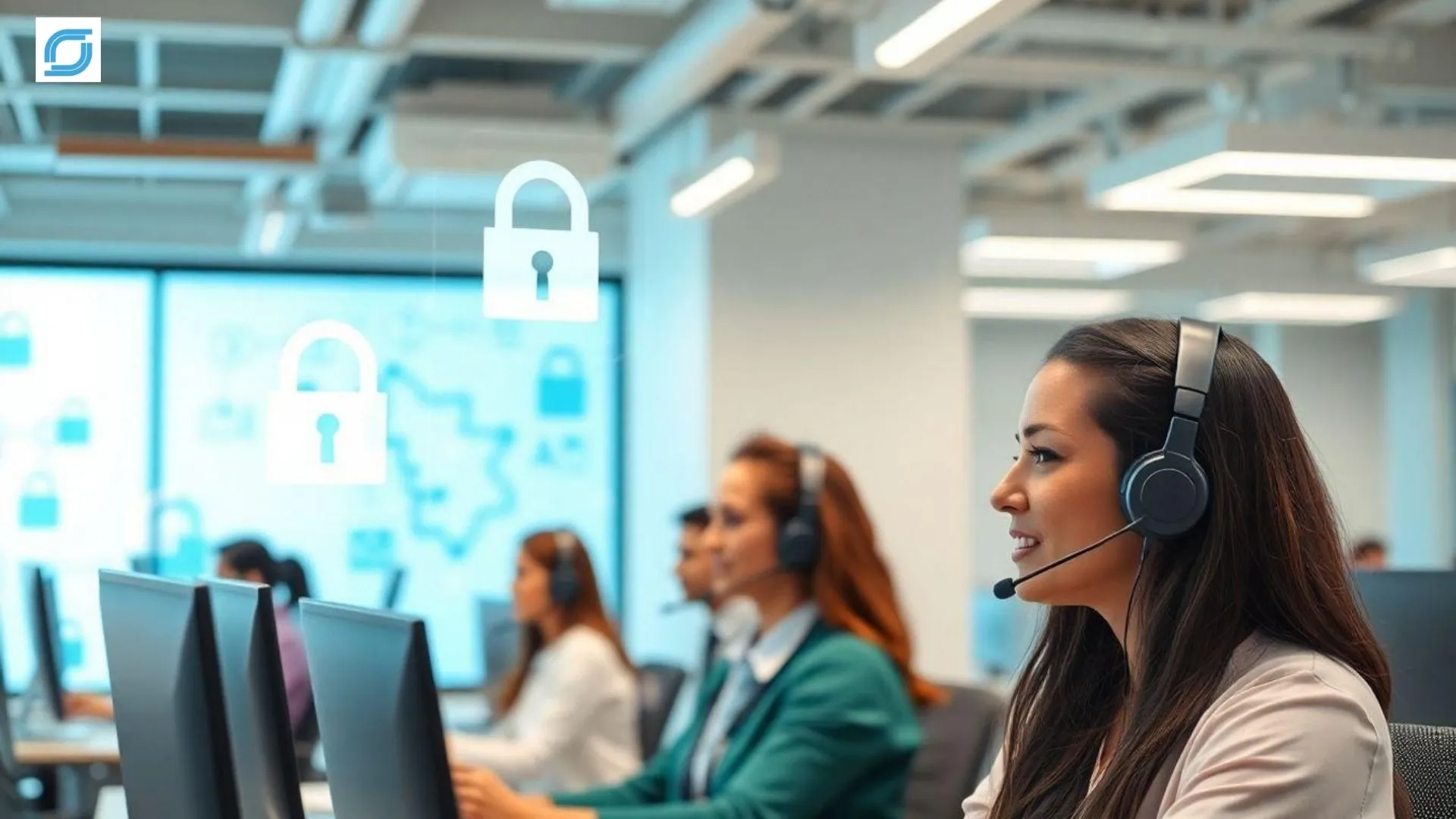
For telecom call centers and telecom BPOs, the stakes are higher. Volumes are massive. Calls carry sensitive billing and identity data. And regulators watch closely. So a 2% sample is a serious gap.
Automated, AI-powered call monitoring closes it. It gives full compliance coverage, faster coaching, and better CSAT — with no extra headcount. That is why leading telecom BPOs are moving to AI-powered quality management now. Better contact center quality assurance is no longer a luxury. It is a baseline.
See Every Call, Not Just a Few
Manual call monitoring made sense when full coverage was impossible. It is not impossible anymore. In telecom, sampling 2% of calls means ignoring the other 98%. That is a risk you no longer have to take.
Stop Scoring 2% And Hoping The Rest Are Fine.
Sequential Tech, runs AI-powered call monitoring that scores up to 100% of calls, chats, and messages — flagging compliance and coaching moments in real time, with about 80% less manual QA work.