A buyer’s guide to choosing AI quality management for telecom call centres: the criteria, scorecard, and vendor questions that lead to the right AI QMS.
The AI QA market is booming. New tools launch every month, each promising perfect quality and instant compliance. For a telecom leader, that is both good news and a headache. How do you tell a real solution from clever marketing? Pick the wrong one, and you waste budget and trust. Pick the right one, and you gain full coverage and faster coaching. This guide shows you how to choose AI quality management for telecom call centers with clear criteria, a simple scorecard, and the right questions to ask.
Why Telecom Call Centers Need AI QMS
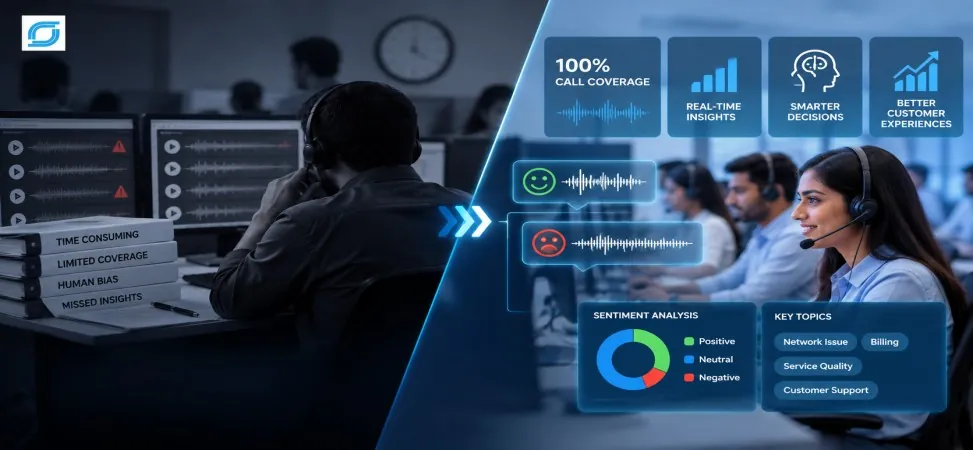
First, a quick reminder of the problem. Manual QA cannot keep up. A human reviewer checks only 1% to 5% of calls. So most conversations go unscored. In telecom, that gap is risky. Here is what a manual-only program misses:
- Compliance slips on calls no one heard.
- Frustrated customers who churn quietly.
- Coaching moments that never reach agents.
- Fraud signals that go unnoticed.
An AI QMS fixes this. It scores up to 100% of calls in real time. So the real question is not whether to adopt one. It is how to choose the right one. And the wrong choice is costly. A weak tool wastes budget and leaves gaps.
What an AI QMS Actually Does
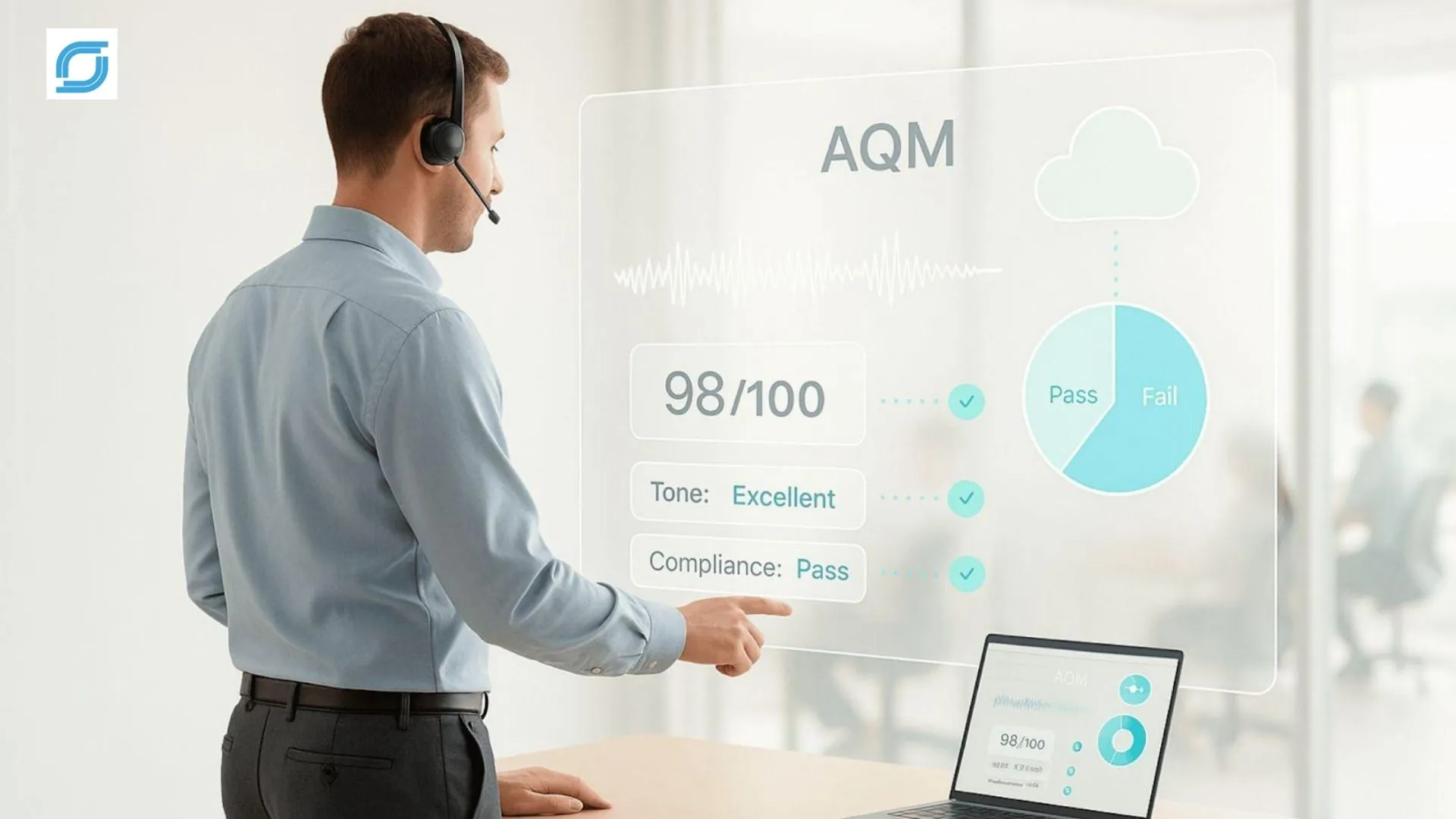
An AI quality management solution automates call and chat scoring. It listens to every interaction. Then it grades compliance, tone, and accuracy. It also reads sentiment and flags risks in real time. Finally, it turns scores into coaching for agents.
In practice, it works in five simple steps:
- Capture every call, chat, and message.
- Analyze each one for compliance and tone.
- Flag risks and coaching moments in real time.
- Report trends on clear dashboards.
- Coach agents with specific feedback.
In short, AI QMS replaces slow spot-checks with full, fast, and fair telecom contact center quality assurance.
How to Choose an AI QMS: A 6-Step Process
Choosing well is a process, not a guess. So follow these six steps.
I. Define your goals. Decide what to fix first. Compliance, CSAT, or coaching. Clear goals guide every later choice.
II. Map your compliance needs. List the rules you must meet. PCI, consent, and disclosures. Your AI QMS must cover them.
III. Shortlist telecom-ready vendors. Favor tools built for telecom, not generic QA. Telecom terms and workflows matter. So ask for telecom case studies, not generic ones.
IV. Run a pilot. Test on your real calls. Check accuracy, coverage, and ease of use before you commit.
V. Score each option. Use the scorecard below. Rate every tool on the same criteria.
VI. Compare total cost. Look beyond the license. Include setup, training, and time to value.
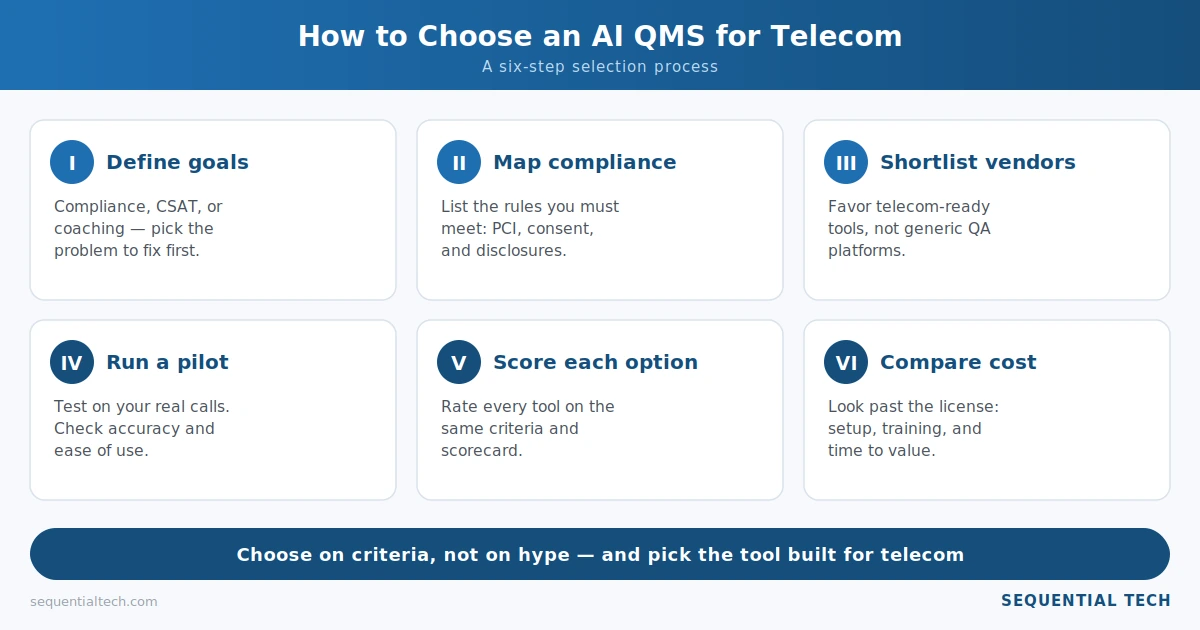 A six-step process for choosing an AI QMS built for telecom call centres.
AI QMS Evaluation Criteria
Use this scorecard to rate each vendor. The criteria below separate a strong AI QMS from a weak one.
| Criterion | What to Look For | Why It Matters |
|---|---|---|
| Coverage | Scores up to 100% of calls and chats | No blind spots |
| Telecom compliance | Built-in PCI, consent, disclosure checks | Avoids fines |
| Real-time analysis | Flags issues during the call | Fixes problems fast |
| Sentiment and scoring | Reads tone, not just keywords | Catches hidden churn |
| Integrations | Connects to telephony, CRM, OSS/BSS | Easy rollout |
| Coaching tools | Turns scores into agent feedback | Lifts performance |
| Security | SOC 2, PCI DSS, ISO 27001 | Protects data |
| Analytics | Clear dashboards and trends | Guides decisions |
| Telecom expertise | Vendor knows telecom workflows | Faster results |
Questions to Ask Every Vendor
A demo can hide as much as it shows. So ask hard questions before you sign:
- What share of calls do you actually score?
- How do you handle telecom compliance rules?
- How fast do flags reach a supervisor?
- Which systems do you integrate with?
- How long until we go live?
- How do you keep our data secure?
Clear, confident answers signal a strong partner. Vague ones are a warning.
Red Flags to Avoid
Some warning signs should give you pause. So watch carefully if you see these:
- Sampling only, not full coverage.
- No telecom compliance features.
- Delayed, batch-only scoring.
- No proof of accuracy on real calls.
- A long, heavy setup with no pilot.
- Vague answers on security.
Each red flag adds risk. A strong AI QMS clears them all.
The 2025–2026 Data Telecom Leaders Should Know
The case for AI QMS is strong. Here is where the numbers sit today:
- Coverage. Manual QA reviews 1% to 5% of calls. AI scores up to 100%.
- Cost. AI review costs about $0.20 per call, versus $5.50 by hand — a 96% cut.
- Results. Full-coverage analytics lift CSAT by about 10% and cut costs 20% to 30%, per McKinsey.
- Workload. A good AI QMS cuts manual QA work by about 80%.
- Adoption. By 2025, about 80% of service teams use some form of AI.
- Speed. AI surfaces coaching moments in hours, not weeks.
So the tools are proven. The choice is about fit, not faith. For a neutral view of QA standards, COPC’s guidance on AI quality monitoring is a useful reference.
What to Expect After You Choose
A good rollout is smooth and fast. So ask the vendor for a clear plan. Most strong AI QMS deployments follow the same path. First, a short pilot on your real calls. Next, integration with your telephony and CRM. Then a phase where AI runs beside your manual QA. Finally, full coverage as trust grows. Many telecom teams reach measurable results in about eight weeks. If a vendor cannot show this path, treat it as a warning. A clear plan is a sign of a mature partner.
What This Means for Telecom BPOs
For telecom call centers and telecom BPOs, the right AI QMS is a real edge. It gives full compliance coverage, faster coaching, and better CSAT with no extra headcount. But the tool must fit telecom. Generic QA misses telecom terms, rules, and workflows. So weigh every option against the criteria above. The best choice is the one built for how telecom actually runs.
Choose the AI QMS That Fits Telecom
The right AI QMS does more than score calls. It protects compliance, guides coaching, and scales with you. So choose on criteria, not on hype. Run a pilot, score each vendor, and pick the one built for telecom.
Don’t Buy QA Hype, Buy Full Coverage That Fits Telecom.
Sequential Tech, a Fusion CX company, runs an AI QMS built for telecom, scoring up to 100% of calls, chats, and messages, with real-time compliance flags and about 80% less manual QA work, alongside customer care and technical support.