

The American internet market never sits still for long. Fiber builders keep ripping out copper. 5G home internet steals millions of cable customers every year. Meanwhile, satellites now beam usable broadband to farms that waited decades for a wire. So who actually leads this race? Today we answer that question differently than most lists do. Most rankings of the top broadband service providers in the USA lean on a single number. Some count subscribers. Others measure download speeds. A few simply repeat last year’s list. Honestly, none of those tells the whole story of who serves Americans best. Therefore, this analysis blends three dimensions into one hybrid score. We weighted coverage and subscriber scale at 40%, real-world speed performance at 30%, and value plus customer experience at 30%. Every input comes from published Q4 2025 and early 2026 company results, FCC broadband data, the American Customer Satisfaction Index, and independent speed tests. As a result, the ranking rewards providers customers actually keep.
How We Ranked America’s Internet Service Providers
Each provider received three normalized scores between 0 and 100. Coverage scores reflect broadband subscribers and homes passed from Q4 2025 and Q1 2026 filings. Speed scores blend advertised tiers with measured real-world performance. Value and CX scores combine satisfaction data, pricing transparency, contract terms, and published complaint rates. Then we applied the weighting formula and ranked the results from highest to lowest. The list covers facilities-based providers serving American homes across cable, fiber, fixed wireless, and satellite. Furthermore, it deliberately mixes national giants with regional specialists, because that mix reflects how Americans actually buy internet, by address, not by brand. One caveat deserves stating openly. Hybrid scores are illustrative composites built from different measurement methods, so treat the ranks as directional rather than exact. Footprints, prices, and speeds vary street by street. Even so, the story these scores tell about market leadership holds up well.The Top Broadband Service Providers in the USA at a Glance
| Rank | Provider | Hybrid Score | Subscribers | Why It Ranks Here |
|---|---|---|---|---|
| 1 | Comcast (Xfinity) | 99 | 31.2M | Unmatched scale; multi-gig upgrades offset CX drag |
| 2 | Charter (Spectrum) | 94 | 29.7M | 41 states, no contracts, aggressive rural build |
| 3 | AT&T | 91 | 16.7M | Largest US fiber build; best growth in eight years |
| 4 | Verizon (with Frontier) | 89 | 16.3M | Fios quality plus Frontier fiber and 5G reach |
| 5 | T-Mobile Home Internet | 86 | ~8M | Fastest growth in America; simple pricing wins |
| 6 | Google Fiber | 80 | ~1M+ | Small footprint, best-in-class speed and satisfaction |
| 7 | Cox Communications | 77 | ~5.5M | Largest private ISP; Charter merger pending |
| 8 | Altice USA (Optimum) | 74 | ~4.3M | 8-gig fiber leader in the tri-state region |
| 9 | Lumen (Quantum Fiber) | 71 | ~2.7M | Fast copper-to-fiber conversion at scale |
| 10 | Starlink | 68 | ~2M | Broadband where no cable or fiber reaches |
| 11 | Mediacom | 65 | ~1.5M | Gigabit cable across Midwest smaller markets |
| 12 | Windstream (Kinetic) | 63 | ~1.2M | Rural DSL converted to fiber in 18 states |
| 13 | Astound Broadband | 61 | ~1M | Value pricing inside select major metros |
| 14 | Cable One (Sparklight) | 59 | ~1M | Gigabit for small cities the giants skip |
| 15 | Brightspeed | 57 | ~1M | Fiber across the underserved South and Midwest |
| 16 | Metronet | 55 | ~0.6M | 100% fiber cities, now inside T-Mobile’s venture |
| 17 | Breezeline | 53 | ~0.7M | East Coast coverage from Ohio to Florida |
| 18 | WOW! Internet | 51 | ~0.5M | Budget plans across Midwest and Southeast |
| 19 | TDS Telecom | 49 | ~0.5M | Steady fiber expansion in small-town America |
| 20 | Ziply Fiber | 47 | ~0.4M | Pacific Northwest multi-gig, backed by Bell |
All 20 US Broadband Providers Ranked and Profiled
Now let’s look closer at each provider. Every profile covers the numbers, the strategy behind them, and what operators can learn from it.1. Comcast (Xfinity) — Hybrid Score: 99
Comcast remains America’s largest ISP with 31.2 million domestic broadband customers at the end of 2025, split between roughly 28.7 million residential and 2.5 million business accounts. Its DOCSIS 4.0 upgrade now pushes multi-gig speeds across much of the cable footprint. Internet accounts for about 20% of total company revenue. Scale is also Comcast’s problem. The company keeps losing customers to fiber rivals and 5G home internet, so it competes hard on price locks, free mobile lines, and bundled perks. What operators can learn here is simple: scale buys time, not loyalty. Comcast’s counterattack depends on support quality and install reliability far more than on another speed tier. Worth a Read — Why Broadband Subscribers Churn and How the Right Support Model Fixes It2. Charter (Spectrum) — Hybrid Score: 94
Charter serves 29.7 million internet customers across 41 states under the Spectrum brand. Its pitch stays refreshingly simple: no annual contracts, no data caps, and free mobile lines with bundles. Moreover, Charter won roughly $1.2 billion in FCC rural funding to reach about one million unserved locations, with construction running toward 2027. Spectrum Mobile has become the company’s quiet weapon, converting broadband homes into wireless customers at high rates. Additionally, a pending $34.5 billion merger with Cox could push Charter past 35 million subscribers. For operators, Charter shows how simplified pricing removes a major churn trigger before support ever gets involved.3. AT&T — Hybrid Score: 91
AT&T counts about 16.7 million consumer broadband subscribers, including 10.4 million on fiber and roughly 2 million on Internet Air fixed wireless. The company posted 558,000 broadband net additions in Q3 2025, its strongest quarter in over eight years. Its fiber network now passes well beyond 30 million locations. Fiber plus wireless bundling gives AT&T some of the lowest churn in American telecom. Customers holding both services simply leave less often. Therefore, the lesson for operators is that bundling only works when the support experience is unified too. One bad billing call can undo two strong products.4. Verizon (Including Frontier) — Hybrid Score: 89
Verizon’s broadband base reached roughly 16.3 million connections after the $20 billion Frontier acquisition closed in January 2026. That total combines about 7.3 million Fios customers, 5.7 million fixed wireless subscribers, and Frontier’s fiber footprint. Fios continues to score among the highest in customer satisfaction nationally. Integration is now the real test. Merging two support organizations, two billing systems, and two service cultures creates exactly the friction that drives churn. Consequently, Verizon’s 2026 performance will hinge on how invisibly it absorbs Frontier’s customers rather than on network quality alone.5. T-Mobile Home Internet — Hybrid Score: 86
T-Mobile is the fastest-growing name in American broadband, approaching 8 million customers on 5G fixed wireless. Its base grew 34% year over year in Q3 2025, adding 560,000 net customers in a single quarter. Most of those households switched from cable. Simplicity powers the momentum. One flat price, no contracts, no installer visit, and a five-minute self-setup remove nearly every friction point cable created. In short, T-Mobile proved that a slower connection with a better experience still wins millions of American homes.6. Google Fiber — Hybrid Score: 80
Google Fiber ranks sixth despite serving barely one million customers, and that gap is the whole point of a hybrid score. The service delivers symmetric speeds up to 8 Gbps across roughly 20 metro areas, with straightforward pricing and consistently top-tier satisfaction ratings. Customers stay because almost nothing goes wrong. No data caps, no promotional roll-offs, no equipment rental games, and few reasons to call support in the first place. For operators, Google Fiber is the clearest proof in this ranking that customer experience compounds faster than footprint.7. Cox Communications — Hybrid Score: 77
Cox serves roughly 5.5 million broadband customers across 18 states as America’s largest privately held ISP. Its pending $34.5 billion combination with Charter remains under regulatory review and would reshape the top of this list entirely. Private ownership let Cox invest in service depth without quarterly pressure, and its satisfaction scores generally beat larger cable peers. However, merger uncertainty now risks exactly the service disruption that sends subscribers shopping. Retention teams matter most during transitions like this one. Worth a Read — Broadband Technical Support Outsourcing: What US Providers Actually Gain8. Altice USA (Optimum) — Hybrid Score: 74
Optimum serves about 4.3 million broadband subscribers, concentrated in the New York tri-state region. Notably, Altice markets the nation’s largest 8-gig fiber service, with more than 1.7 million homes and businesses able to order it today. The company is racing to convert its remaining cable plant to full fiber while defending against Verizon Fios and 5G home internet on the same streets. That is the toughest competitive position on this list. As a result, Optimum leans heavily on retention offers and win-back campaigns to hold its base.9. Lumen (Quantum Fiber) — Hybrid Score: 71
Lumen serves roughly 2.7 million broadband customers while converting legacy CenturyLink copper into Quantum Fiber at pace. Its enterprise backbone also carries a growing share of America’s AI data center traffic, which helps fund the consumer build. Copper-to-fiber migration is operationally brutal. Every conversion involves scheduling, truck rolls, equipment swaps, and confused customers. Therefore, Lumen’s consumer results depend as much on activation and onboarding execution as on the fiber itself.10. Starlink — Hybrid Score: 68
Starlink rewrote rural America’s internet story with around 2 million US subscribers. Its low-earth-orbit satellites deliver genuinely usable broadband to homes that no cable or fiber build will ever reach economically. Customers accept higher prices and weather variability because the alternative is often nothing at all. Moreover, self-install kits eliminate the truck roll entirely. Starlink shows that removing a service barrier can matter more to households than raw performance.11. Mediacom — Hybrid Score: 65
Mediacom anchors smaller Midwest markets with about 1.5 million customers and gigabit speeds across nearly its entire footprint. Serving towns the giants skip gives it pricing power that big-city cable operators no longer enjoy.12. Windstream (Kinetic) — Hybrid Score: 63
Kinetic serves roughly 1.2 million customers while converting rural DSL lines to fiber across 18 states. Federal and state broadband grants fund much of that build. Consequently, its subscriber mix keeps improving in quality even when totals stay flat.13. Astound Broadband — Hybrid Score: 61
Astound operates about one million connections inside select major metros, competing on price against far larger incumbents. Its strategy targets value-focused households in dense markets where switching costs are lowest.14. Cable One (Sparklight) — Hybrid Score: 59
Sparklight delivers gigabit service to small cities across 24 states, serving roughly one million customers. Limited competition supports strong margins, though fixed wireless is now arriving in those same towns.15. Brightspeed — Hybrid Score: 57
Brightspeed is building fiber across underserved parts of the South and Midwest, reaching about one million customers. Its entire thesis rests on replacing aging copper before a competitor arrives first. Worth a Read — How Installation and Activation Support Shapes Broadband Customer Loyalty16. Metronet — Hybrid Score: 55
Metronet builds 100% fiber networks city by city, serving roughly 600,000 customers. T-Mobile’s fiber joint venture acquired the company, giving it national backing and a wireless bundling partner overnight.17. Breezeline — Hybrid Score: 53
Breezeline serves about 700,000 customers along an East Coast footprint stretching from Ohio to Florida. Regional focus lets it tailor service and pricing far more closely than national operators can.18. WOW! Internet — Hybrid Score: 51
WOW! serves roughly 500,000 customers across Midwest and Southeast markets with budget-friendly plans and no contracts. Straightforward pricing remains its clearest differentiator against cable incumbents.19. TDS Telecom — Hybrid Score: 49
TDS steadily expands fiber through small-town America, serving about 500,000 customers. Patient, grant-supported building keeps it relevant in communities the largest providers overlook entirely.20. Ziply Fiber — Hybrid Score: 47
Ziply delivers multi-gig fiber across the Pacific Northwest to roughly 400,000 customers. Backing from Bell Canada funds an aggressive build in a region where fiber demand still outpaces supply.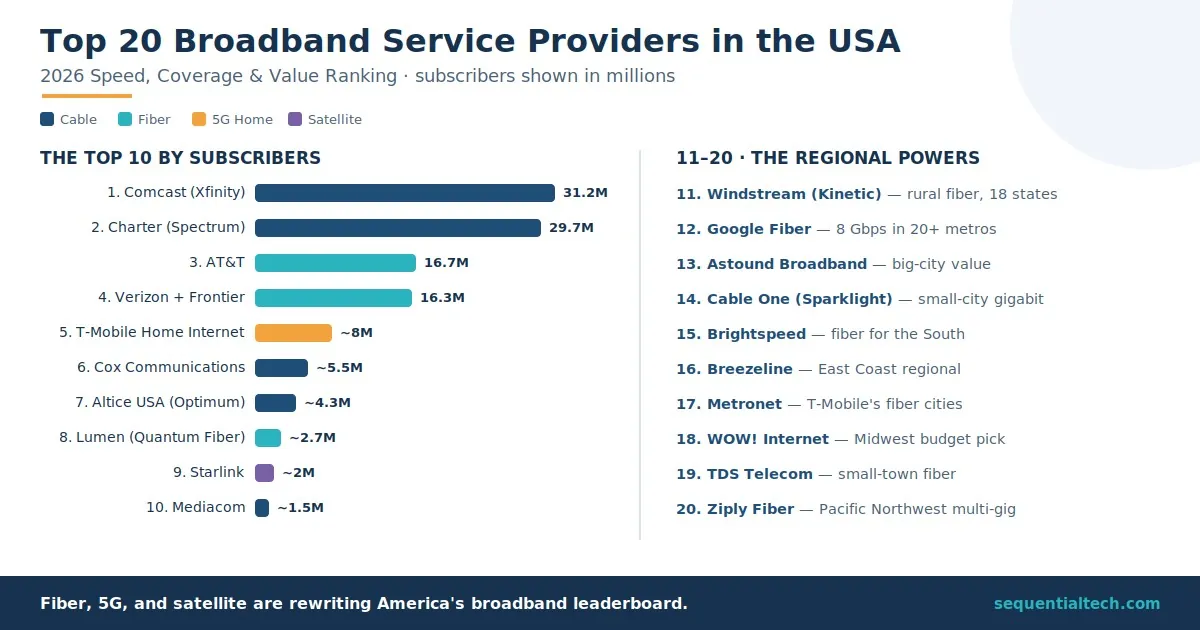
What These 20 Providers Reveal About Broadband Customer Experience
Looking across the full list, three patterns stand out. First, customer experience predicts future position better than current subscriber counts. Google Fiber ranks sixth with roughly one million customers, while providers thirty times larger sit below it. That gap will widen, not close. Second, the switching decision now happens outside the network entirely. Households leave over install delays, billing surprises, and unresolved support tickets. Speed rarely appears in cancellation reasons. Therefore, the contact center has become the real competitive battleground in US broadband. Third, consolidation is accelerating fast. Verizon absorbed Frontier, Charter is pursuing Cox, and T-Mobile bought Metronet. Each merger creates a migration window when support quality either protects the base or hands it to rivals. Consequently, execution during transitions now decides market share more than acquisition price does.The Pain Point: Subscribers Now Switch Faster Than Ever
Before the list, understand the pressure every provider on it faces daily:- Most American homes now have three or more real options. This is the biggest pain point in US broadband. Choice turns every service failure into a switching trigger.
- 5G home internet converts in minutes. T-Mobile grew its broadband base 34% year over year in Q3 2025, largely from cable defectors.
- Installation problems start churn early. A missed appointment in week one often predicts a cancellation by month six.
- Billing confusion drives more calls than outages. Surprise charges and promo roll-offs create disputes that quietly erode trust.
- Support quality decides who keeps the customer. When speeds look similar, the last bad service call becomes the reason people leave.
Why Outsourced Support Drives America’s Top Broadband Providers
Notice how every provider in the top ten runs serious customer support infrastructure. Some build internal teams. Others partner with specialist telecom BPO providers for overflow capacity, overnight coverage, or multilingual support. Furthermore, the strongest performers blend both rather than treating outsourcing purely as a cost cut. The economics changed sharply over the past five years. Wages rose, technical training requirements expanded, and subscriber expectations climbed faster than internal teams could hire. Meanwhile, install volumes spike unpredictably during fiber builds and promotional pushes. Outsourced support became a capacity strategy rather than a budget line. US providers evaluating partners should look for three things: proven broadband expertise across installs, billing, and technical triage; infrastructure that absorbs three-to-five-times volume spikes; and quality monitoring that holds one brand voice across every agent. Delivery location matters too, which is why many operators now compare onshore, nearshore, and offshore models before committing.Where US Broadband Is Heading Next
Three shifts will reshape this ranking within three years. First, fiber keeps winning nearly every head-to-head market it enters, so the providers building fastest today will climb hardest tomorrow. AT&T, Verizon, and the regional fiber players are all betting accordingly. Second, fixed wireless will keep converting frustrated cable households at scale. T-Mobile and Verizon can now sell broadband to any home in coverage without a truck roll. That removes the single biggest friction point in the entire buying process. Third, customer experience will become the dominant moat as speeds commoditize. Once every option delivers a gigabit, the differences that remain are billing clarity, install reliability, and how a support call actually goes. Honestly, that race rewards operators who invested early and punishes everyone else.What America’s Top Broadband Providers Teach Every Operator
The top broadband service providers in the USA share three uncomfortable truths. First, scale alone cannot offset a deteriorating service experience. Second, the households you already have cost far less to keep than the ones your marketing chases. Third, the providers climbing this list treat support as a growth function rather than an expense. Comcast and Charter still lead on raw size. Google Fiber and T-Mobile climb because customers genuinely like them. Every regional provider here survives by serving a specific place better than a national brand bothers to. The same dynamic plays out across the wider industry, as our ranking of the top telecom companies in the USA shows. So where does your operation actually stand? Are you building support infrastructure that compounds loyalty year after year? Or are you treating the contact center as a cost to trim while competitors quietly take your subscribers? The providers at the top of this list made that choice years ago.THE SUPPORT ENGINE BEHIND AMERICA’S BROADBAND RACE
Sequential Tech helps US internet service providers win the switching war where it’s actually fought: the subscriber experience. We support regional cable operators, fiber overbuilders, fixed wireless and 5G home internet providers, rural and municipal broadband networks, MVNOs, and MSOs, the challengers competing against the giants on this list. Our telecom-trained teams deliver broadband customer care, technical support, installation and activation support, billing and order management, retention and win-back, and 24/7 multilingual coverage, all backed by AI-powered quality monitoring and flexible onshore, nearshore, and offshore delivery. In short, we keep your subscribers connected and loyal while you build the network. Talk to Our Broadband Support Experts →Operators mapping the competitive landscape usually start with a market overview — our ranking of the top MVNO providers in the USA breaks down the leading names.
The warning signs add up quickly, which is why many teams look for a U.S.-based telecom customer support partner.