Learn how to handle angry customers with seven simple de-escalation steps, sample phrases, and escalation rules that help telecom care teams calm callers down fast.
Maria’s home internet has been down for six days. She has called three times. Each time, she explained the outage from scratch, sat through hold music, and heard “we’re working on it.” On her fourth call, she skips the hello. “I want to cancel. Now.”
Every telecom agent knows this caller. What happens in the next five minutes decides whether Maria stays or leaves. This guide shows how to handle angry customers with seven de-escalation steps you can use on your next call. It also covers what to say, what to avoid, and when to escalate.
To handle angry customers, stay calm, let them finish, and name their frustration. Then restate the problem so they don’t repeat it, take ownership, offer clear options, and follow up. Escalate only for abuse or for issues beyond your authority.
Why Telecom Customers Get Angry
Telecom problems hit daily life hard. When internet or phone service fails, people can’t work, study, or reach family. Add a surprise charge, a long hold, or a third transfer, and patience runs out fast.
The emotional toll is real. In Parloa’s Consumer Patience Index, a June 2026 study of 1,001 US adults, 55.9% reported at least one extreme reaction to a frustrating chat or phone session. Those reactions included rage-quitting a subscription (32%), yelling at a loved one (16.5%), and crying (14%). Parloa sells customer service AI and commissioned the study. Still, the pattern matches what agents hear every day.
Repeating information is a major trigger. The same research found that 10% of people quit an automated interaction the first time they must repeat something. That’s one reason disconnected support channels cost providers so many subscribers.
For telecom customer care teams, every angry call is also a retention moment. Our guide to churn reduction through better care shows how much those moments matter.
How to Handle Angry Customers: 7 De-Escalation Steps
These steps work on the phone, in chat, and in person. Use them in order, but stay flexible.
1. Stay Calm and Don’t Take It Personally
The customer is angry at the situation, not at you. Keep your voice low and steady, and slow your pace a little. A calm tone spreads, and so does a sharp one.
Try saying: “I can hear how frustrating this has been. I’m here to help you sort it out.”
2. Listen Without Interrupting
Let the customer finish, even if you already know the fix. Interrupting tells them you aren’t listening. Take short notes so you can repeat the key details later.
Try saying: “Please go on. I want to make sure I have the full picture.”
3. Acknowledge the Feeling, and Apologize Where It Fits
Name the emotion before you solve the problem. If the company made a mistake, apologize clearly and without excuses. If it didn’t, you can still be sorry about how the situation feels.
Try saying: “Six days without internet is a long time. I’m sorry we let you down.”
4. Restate the Problem So They Don’t Repeat It
Read back what you heard, using the account notes in front of you. This shows the customer that someone finally has the whole story. It also catches mistakes early.
Try saying: “So your service has been down since Tuesday, and you’ve called three times. Is that right?”
5. Take Ownership and Explain What You’ll Do
Don’t pass the blame to another team. Use “I,” and tell the customer the exact steps you’re taking right now.
Try saying: “I’m going to check the outage ticket now and see what’s holding it up.”
6. Offer Options and Set Clear Next Steps
Give the customer a choice where you can, such as a technician visit, a temporary hotspot, or a bill credit. Then give a clear time frame and stick to it.
Try saying: “I can book a technician for Thursday morning or send a hotspot today. Which works better for you?”
7. Follow Up and Close the Loop
Before you end the call, recap what will happen and when. Then follow up as promised, even if it’s just to say the fix is on track. A promised callback that never comes creates the next angry call.
Try saying: “I’ll call you Thursday at noon to confirm the technician fixed it.”
What to Say vs. What Not to Say
Small word choices can calm a caller or set them off. Here are seven common swaps.
| Instead of saying | Try saying |
|---|---|
| “Calm down.” | “I can hear how upsetting this is.” |
| “That’s not my department.” | “Let me find the right person and stay with you.” |
| “There’s nothing I can do.” | “Here’s what I can do right now.” |
| “You need to…” | “Could we try…” |
| “As I already said…” | “Let me explain that another way.” |
| “It’s company policy.” | “Here’s why we do it this way, and what we can try.” |
| “I don’t know.” | “Let me find out for you.” |
When to Escalate or End the Call
Most angry callers calm down once they feel heard. Still, some calls need a supervisor. Escalate when:
- Threats or abusive language continue after a warning
- The fix needs approval beyond your authority, such as a large credit
- This is their third or fourth call about the same issue
- A formal complaint is on the table
If abuse continues, give one calm warning. Then end the call politely and log what happened. Your safety matters, too.
Formal complaints need extra care. When a customer files a telecom billing or service complaint with the FCC, the provider has 30 days to respond, as the FCC’s complaint guide explains. A quick supervisor callback often solves the issue before it gets that far.
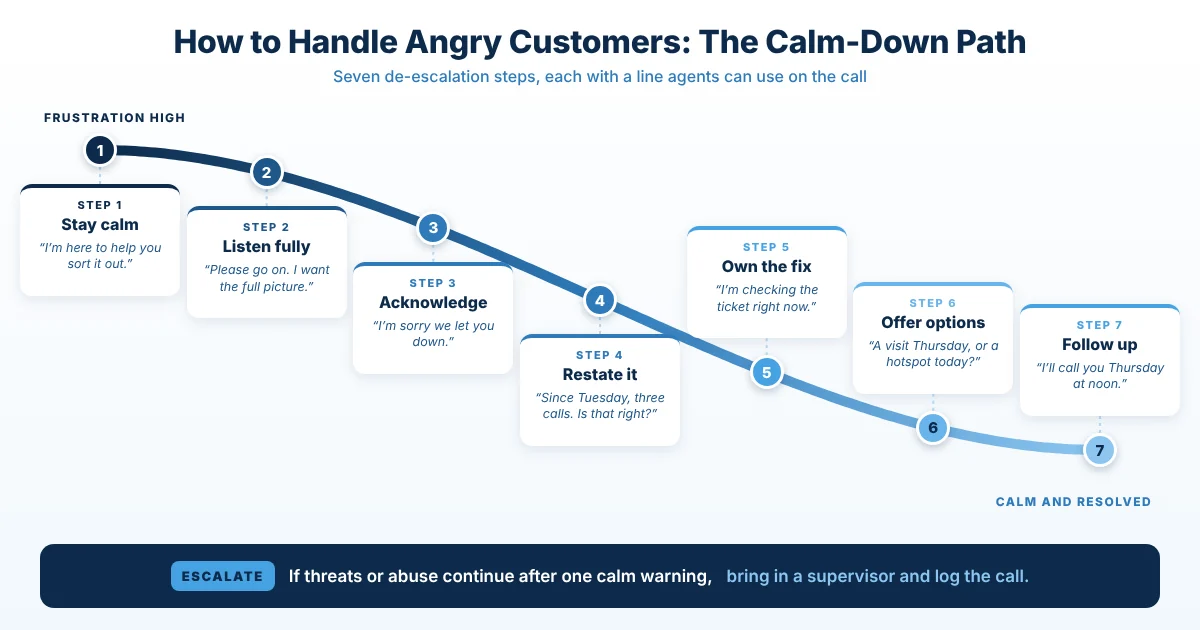 The seven steps that turn an angry call into a calm one.
How Care Teams Can Prevent Angry Calls
The best de-escalation happens before the call even starts. Parloa found that one-third of consumers would rather switch brands than be put on hold. Moreover, CMSWire noted in October 2026 that repeated information, long waits, and transfers still top customer complaints, just as they did in 2021.
So the biggest fixes are simple. Route calls to the right agent the first time. Keep holds short, or offer a callback. Put account history in front of every agent, so customers never start from zero.
Patience also varies by age. In a July 2026 survey of 2,003 US consumers, people over 55 gave up on hold after 7 minutes for a routine call. Those aged 18 to 24 waited 17. Our guide to care for older adults covers how to support them.
Turn Angry Calls Into Loyal Customers
Angry callers are not lost causes. With the right words and a clear process, most leave the call calmer than they started. Sequential Tech’s telecom customer care services give US carriers, MVNOs, and broadband providers trained agents who listen with empathy, own the fix, and follow up on time. Talk to our telecom customer care experts to build a care team your customers are glad to reach.
Frequently Asked Questions
How do you handle angry customers?
To handle angry customers, stay calm and let them finish speaking. Acknowledge their frustration, restate the problem, and take ownership of the next step. Then offer clear options, set a time frame, and follow up as promised. Escalate only for abuse or issues beyond your authority.
What should you not say to an angry customer?
Avoid phrases like “calm down,” “that’s not my department,” “there’s nothing I can do,” and “it’s company policy.” They sound dismissive and often make anger worse. Instead, acknowledge the feeling and explain what you can do right now.
How do you calm an angry customer on the phone?
Lower your voice, slow your pace, and let the customer finish without interrupting. Name their frustration, then read back the problem so they know you understand. Give one clear next step with a time frame. A calm, steady tone helps the caller settle faster.
When should an agent escalate an angry customer?
An agent should escalate when the customer stays abusive after a warning or asks for something beyond the agent’s authority. Repeated calls about the same issue and plans to file a formal complaint are also good reasons. A supervisor can approve larger fixes and protect the agent.
Why are telecom customers often angry when they call?
Telecom customers often call after something has already gone wrong, such as an outage, a surprise charge, or a failed fix. Long holds, repeated transfers, and having to explain the issue again add to the frustration before the agent even says hello.