

Discover how AI-powered telecom call center quality management scores 100% of calls to cut compliance risk, lift CX, and turn every interaction into coaching insight.
Right now, most telecom operators listen to only a sliver of their calls. Manual QA reviews just 1% to 5% of interactions. So what happens to the other 95%? Usually, nobody checks it. Yet that blind spot hides real danger. Inside it sit missed consent, skipped disclosures, and frustrated customers. Each one can become a compliance fine or a lost subscriber. AI-powered telecom call center quality management closes that gap. It scores every call, chat, and message in real time. As a result, risk no longer hides.
The Real Pain Point: Sampling Leaves You Blind
Traditional quality assurance was built for a slower era. Back then, a few sampled calls felt like enough. Today, however, it isn’t. In fact, sampling is the single biggest weakness in telecom QA.
Here is what a 1–5% sample misses:
- Compliance breaches on unseen calls. A skipped disclosure on an unsampled call stays invisible until it becomes a lawsuit.
- Repeat CX failures. The same script gap frustrates thousands of customers before one review ever catches it.
- Coaching blind spots. Agents can’t fix mistakes that nobody flagged.
- Delayed feedback. Reviews land days later, so bad habits stick.
- Inconsistent scoring. Two reviewers grade the same call differently, which skews your data.
In short, sampling tells you almost nothing about the calls that matter most. Meanwhile, the risks keep growing.
Why Telecom Feels This Most
Telecom sits in a high-risk category. Call volumes are huge. Every day, agents handle payment data, identity checks, and contract terms. On top of that, regulators watch the industry closely. So one weak sample rate multiplies risk fast. A tiny error rate on millions of calls becomes a large exposure. That is exactly why telecom call center quality management needs full coverage, not a sample.
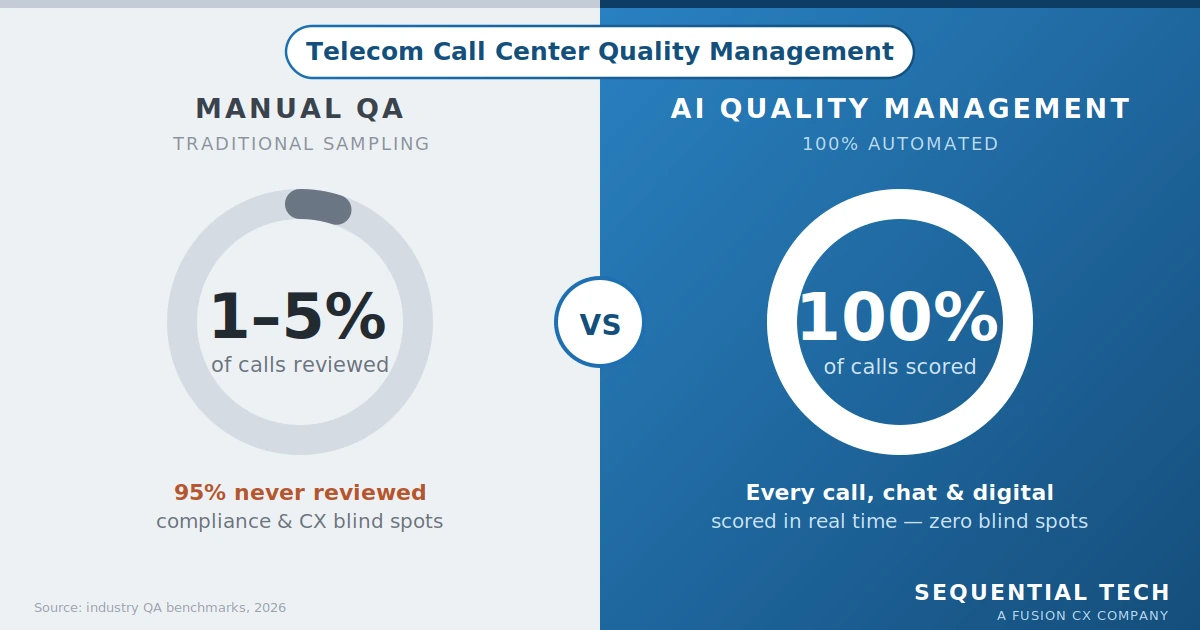 Manual QA samples 1–5% of telecom calls, while AI quality management scores 100%.
What AI-Powered Quality Management Actually Does
The idea is simple. AI-powered telecom call center quality management uses speech analytics and machine learning to score interactions automatically. First, it listens to every call and reads every chat. Then it grades each one for compliance, accuracy, tone, and empathy. Next, it flags risks and coaching moments in real time. Finally, dashboards show quality trends across agents, sites, and lines of business. In fact, it sits at the heart of the broader shift toward AI solutions reshaping telecom customer support.
In practice, the workflow runs in five simple steps:
- Capture every call, chat, and message across all sites.
- Analyze each one for compliance, tone, and accuracy.
- Flag risks and coaching moments in real time.
- Report clear quality trends on leadership dashboards.
- Coach agents with specific, evidence-based feedback.
In other words, it turns a slow spot-check into continuous, operation-wide visibility. Because it covers everything, nothing important slips past.
The 2025–2026 Risk Picture
The stakes keep rising on both sides, compliance and customer experience.
On the compliance side, telecom rules are tightening fast. Under the TCPA, each violation costs $500, and willful ones reach $1,500. Moreover, there is no cap on stacked penalties. One recent verdict hit $925 million for 1.8 million automated calls. Since April 2025, operators must also honor consent-revocation requests within 10 business days. Therefore, a single missed opt-out can create real liability.
On the CX side, the pressure is just as intense. Agent attrition still runs between 30% and 45% every year. As a result, keeping quality consistent is hard. Still, the reward for getting it right is clear. Metrigy’s 2026 benchmarks show early AI adopters gaining a 32.6% lift in CSAT and a 26.7% rise in revenue. Clearly, quality now drives both risk and growth.
Poor CX carries a price tag too. Industry data from Gartner puts agent-assisted contacts near $13.50 each, while self-service runs about $1.84. So every avoidable repeat call adds cost. Better quality means fewer repeats and a lower cost to serve.
Manual QA vs. AI-Powered Quality Management
The contrast is easy to see side by side.
| Dimension | Manual QA (Traditional) | AI-Powered Quality Management |
|---|---|---|
| Coverage | 1%–5% of interactions | Up to 100% of calls, chats, and digital |
| Timing | Feedback days later | Real-time flags and scoring |
| Compliance detection | Misses most unsampled calls | Catches PCI, consent, and disclosure gaps on every call |
| Consistency | Varies by reviewer | Uniform scoring across sites and languages |
| Coaching | Occasional and generic | Continuous and evidence-based |
| Manual workload | High and costly | About 80% lower |
| Risk exposure | Large blind spots | Near-zero blind spots |
The takeaway is simple. Manual QA samples the past, while AI quality assurance for telecom watches the whole operation as it happens.
How It Cuts Compliance Risk
AI quality assurance for telecom changes the math. Instead of sampling, it scores 100% of interactions. Here is how that protects compliance:
I. Full coverage, zero blind spots. The system reviews every call, chat, and digital touch. As a result, no risky interaction slips through.
II. Real-time telecom compliance monitoring. It flags PCI, consent, and disclosure gaps the moment they occur. Therefore, teams fix problems before they escalate.
III. Automatic audit trails. Every score is logged and evidence-based. So when regulators ask, the proof is already there.
IV. Consistent standards everywhere. One engine scores all sites and languages the same way. Because of that, quality stays uniform across your footprint.
Beyond fines, the reputational cost bites harder. News of a data slip travels fast. Customers lose trust quickly, and trust is slow to rebuild. Strong telecom compliance monitoring protects both your budget and your brand.
How It Reduces CX Risk
Strong compliance is only half the story. Telecom customer experience management improves too. These wins map to the top telecom customer experience trends in 2026. Here is how AI-powered quality management lifts CX:
1. Faster problem-solving. Real-time insights help agents resolve issues on the first contact.
2. Consistent empathy. The system scores tone and sentiment, so every customer gets the same level of care.
3. Targeted coaching. Agents receive specific, evidence-based feedback instead of generic training.
4. Early churn warnings. Sentiment analysis spots frustration early, so teams can act before a customer leaves.
Together, these gains lift satisfaction and loyalty. For example, in one Tier-1 telecom program, full AI-driven QA coverage helped push CX to an all-time high of 72.12%. At the same time, communication escalations dropped below 1%. That is the compound effect of watching every conversation, not just a few. Better still, these gains show up in the KPIs every telecom technical support team should track.
The Bottom Line
Compliance risk and CX risk share the same root cause: unseen interactions. Manual sampling can’t fix that, because it looks at too little, too late. AI-powered telecom call center quality management removes the blind spot entirely. As a result, operators protect compliance, coach smarter, and keep more customers.
Put AI-Powered Quality Management to Work
Sequential Tech, brings 20+ years of telecom experience to this exact challenge. Our AI QMS scores up to 100% of interactions, cuts manual QA workload by about 80%, and delivers measurable gains in roughly 8 weeks. Beyond quality management, we also support telecom operators across customer care, technical support, billing, collections, activations, retention, and network operations. Moreover, every deployment meets PCI DSS, SOC 2, HIPAA, and ISO 27001 standards. So if you’re ready to see full-quality visibility in action.