

Six research firms size the telecom order management market very differently. See their 2026 estimates, why they differ, and the key trends driving its growth.
Ask six research firms how big the telecom order management market is, and you’ll get six different answers. The lowest puts it near $1.6 billion in 2026. The highest says it was already worth $7.2 billion in 2025. That’s a wide gap for one market.
Yet every firm agrees on one thing: it’s growing fast. This guide lines up the major estimates for the telecom order management market, explains why they differ, and shows what’s driving growth in 2026.
The telecom order management market is worth about $1.6 billion in 2026 for software alone. When services are included, most estimates fall between $3 billion and $5 billion. Most analysts expect it to grow 10% to 13% a year into the early 2030s.
What the Telecom Order Management Market Includes
Order management takes a customer’s order from the moment they buy to the moment service goes live and billing starts. Our guide to BSS order management walks through that journey step by step.
Analysts split the market into two parts:
- Software: order capture, product catalogs, orchestration, and service order management tools.
- Services: consulting, integration, installation, and ongoing support.
Some reports count only software, while others add services. That choice explains most of the gap you’ll see below. The market also covers specialist work, such as ASR and LSR orders for business circuits and the handoff to order management in telecom billing. Behind every tool, there are also people doing day-to-day telecom order management work.
Telecom Order Management Market Size in 2026
Here’s how six research firms size the market. All figures are third-party estimates, not audited numbers.
| Analyst firm | Base-year size | Forecast | CAGR |
|---|---|---|---|
| Mordor Intelligence (software only) | $1.42B (2025); $1.61B (2026) | $2.87B by 2031 | 12.26% (2026–2031) |
| Coherent Market Insights | $2.76B (2026) | $6.38B by 2033 | 12.7% (2026–2033) |
| Research Nester | $2.9B (2025); $3.1B (2026) | $6.15B by 2035 | 7.8% (2026–2035) |
| The Insight Partners | $4.43B (2025) | $13.29B by 2034 | 12.98% (2026–2034) |
| IMARC Group | $5.0B (2025) | $12.5B by 2034 | 10.55% (2026–2034) |
| IndustryARC | $7.18B (2025) | $19.34B by 2032 | 15.2% (2026–2032) |
Why the Estimates Differ
The gap comes down to scope and method. Mordor Intelligence counts software only, so its figure is the smallest. Firms such as IMARC also count services like integration and consulting, which can double the total.
Each firm also uses its own data, vendor list, and forecast window. So compare growth rates, not just totals. On that measure, most estimates land between 10% and 13% a year.
Where the Growth Is
Mordor’s data shows three clear patterns.
Cloud is winning. Cloud-based tools held 62.11% of revenue in 2025 and should grow 13.78% a year through 2031. Meanwhile, new on-premises contracts make up a shrinking share of deals.
Big operators spend the most, but smaller ones are catching up. Large organizations held 76.13% of revenue in 2025. However, small and medium operators should grow faster, at 13.65% a year through 2031.
North America leads. The region held 34.96% of revenue in 2025, while Asia-Pacific is the fastest-growing region at 13.77% a year. IMARC puts North America’s share even higher, at 37.6%.
What’s Driving the Market, and What’s Holding It Back
Order management is getting harder, not easier. A single customer may now buy fiber, mobile, and smart home services in one order. Each service touches different systems, so operators need tools that can keep up.
Mordor estimates how much each factor adds to, or takes away from, yearly growth.
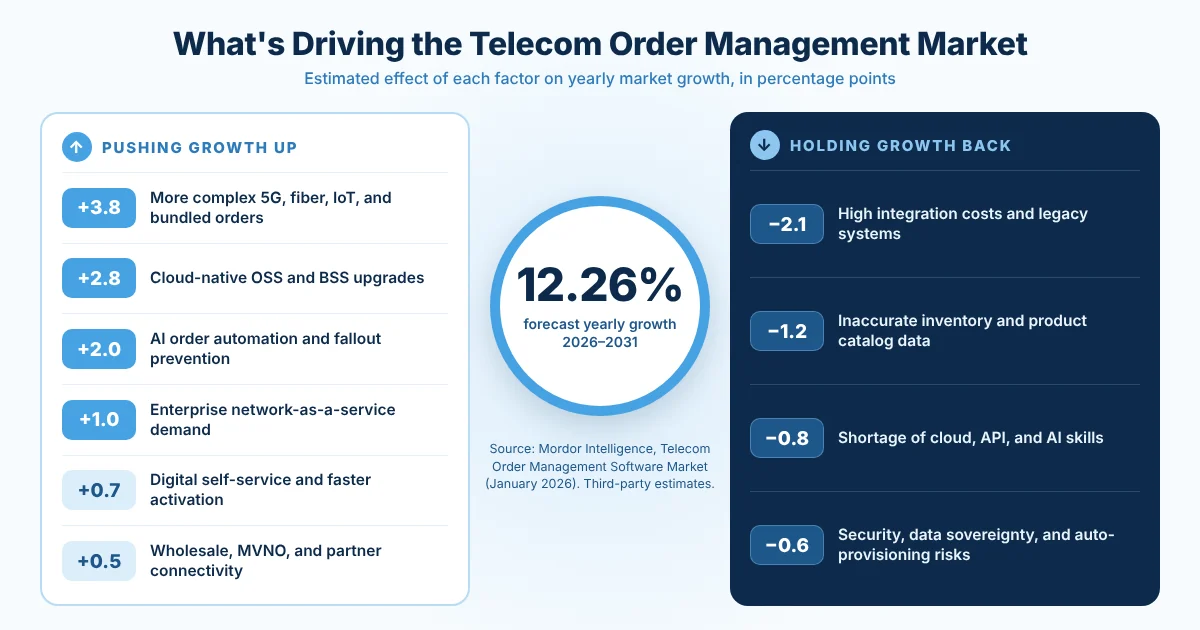 What’s pushing the telecom order management market up, and what’s holding it back.
The biggest push comes from rising order complexity across 5G, fiber, IoT, and bundled services, which adds 3.8 points. Cloud-native OSS and BSS upgrades add 2.8 points. AI-driven order automation and fallout prevention add another 2.0 points.
On the other side, high integration costs and old systems take away 2.1 points. Messy inventory and catalog data cost 1.2 points. A shortage of cloud, API, and AI skills costs 0.8 points.
Key Vendor Moves in 2025–2026
The vendor side is consolidating fast. Here are three moves that stand out:
- December 2025: Amdocs completed its purchase of MATRIXX Software for about $197 million.
- March 2026: Cerillion earned Diamond-level TM Forum Open API certification. Amdocs also launched CES26 with early fallout detection.
- May 2026: NEC, through Netcracker, completed its roughly $2.9 billion purchase of CSG Systems.
Fewer, bigger vendors can mean more complete platforms. Still, it can also mean longer migrations for operators running older products.
Trends to Watch
Agentic AI
Omdia names three key themes for telco software in 2026: vendor consolidation, operators building their own BSS and OSS, and agentic AI. Agentic AI goes beyond suggestions. It can plan and act across systems, such as spotting a stuck order and rerouting it. For now, most operators use it under close supervision.
Cloud-Native BSS
Operators keep moving order tools to the cloud. IDC expects spending on operations and monetization systems to grow 5.2% in 2026, reaching $54 billion. That growth comes even as IDC expects overall telecom capital spending to dip 1.5%.
Open APIs
TM Forum Open APIs let order, catalog, and billing systems talk to each other in a standard way. As a result, operators can add or swap tools without rebuilding everything.
What This Means for Operators
New software helps, but it doesn’t fix everything. PwC notes that many operators still carry decades of process debt. That includes split product catalogs, duplicate billing platforms, brittle order flows, and data that doesn’t match across systems. Those problems don’t vanish with a new tool.
So orders will still fall out, and people will still fix them. The operators that gain the most will pair better software with clean data and skilled order teams. In short, market growth is a chance to rethink both the tools and the work around them.
Keep Every Order Moving
Better order tools are only half the story. Every operator still needs people who catch fallout, fix bad data, and keep installs on schedule. Sequential Tech’s telecom order management teams support US carriers, MVNOs, and broadband and enterprise providers with order entry, ASR and LSR management, provisioning, and MACD work. Talk to our telecom order management experts to keep every order moving, whatever platform you run.
Frequently Asked Questions
How big is the telecom order management market?
It depends on scope. Mordor Intelligence values order management software alone at $1.61 billion in 2026. Firms that also count services put the market higher, from $2.76 billion in 2026 (Coherent Market Insights) to $5.0 billion in 2025 (IMARC Group).
How fast is the telecom order management market growing?
Most analysts expect 10% to 13% growth a year into the early 2030s. The full range runs from 7.8% (Research Nester) to 15.2% (IndustryARC). Cloud-based tools and small and medium operators are growing fastest, according to Mordor Intelligence.
What is driving telecom order management growth?
Rising order complexity across 5G, fiber, IoT, and bundled services is the biggest driver. Cloud-native OSS and BSS upgrades, AI-driven order automation, and business demand for network-as-a-service also push growth, according to Mordor Intelligence’s 2026 analysis.
Which region leads the telecom order management market?
North America leads, with about 35% to 38% of revenue in 2025, depending on the source. Asia-Pacific is the fastest-growing region, at about 13.8% a year through 2031, according to Mordor Intelligence.
Who are the main telecom order management vendors?
Mordor Intelligence names Amdocs, Netcracker, Cerillion, Comarch, and Tecnotree as industry leaders. CSG Systems, Hansen Technologies, Mavenir, and Etiya are also active. Notably, NEC completed its purchase of CSG Systems through Netcracker in May 2026.