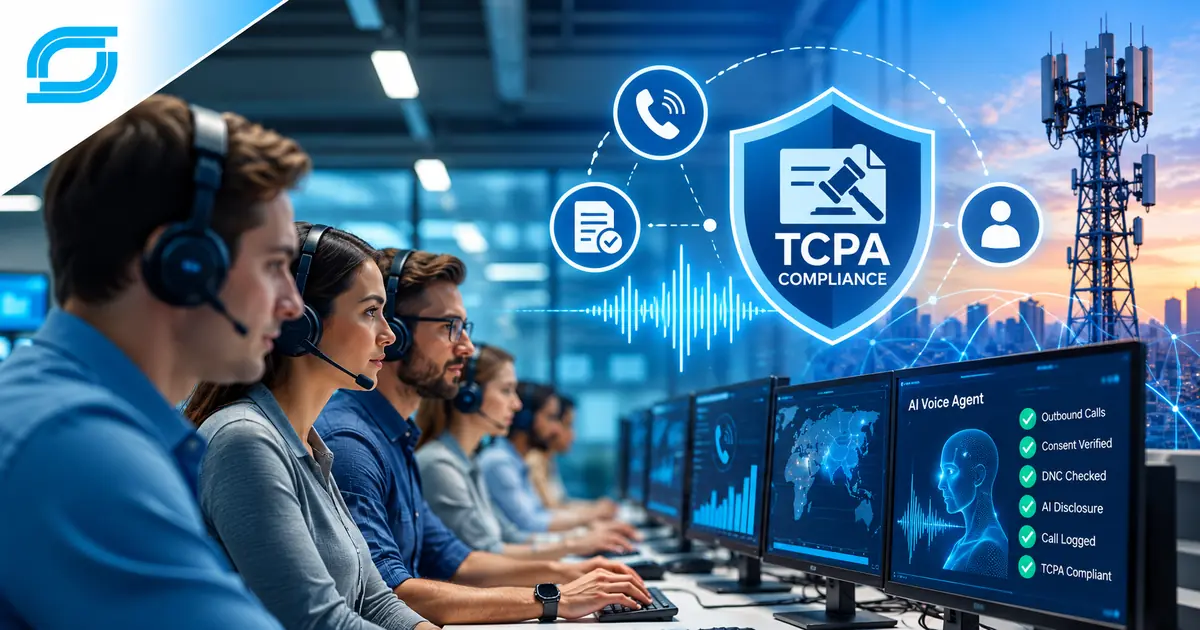
The FCC now treats AI-generated voices as robocalls under the TCPA, so every outbound call your AI agent makes carries legal weight. This guide breaks down the 2026 rules, the penalties, and the simple process that keeps telecom outbound teams compliant.
Your AI voice agent made 50,000 outbound calls last week. It was fast, cheap, and clear. But here is the scary part. If those calls broke the new rules, each one could cost you $500 to $1,500. So do the math, and one busy week could sink a whole program. Since 2024, the FCC treats AI voices like any other robocall. Therefore, the tools that save your team money can also create huge risk. Still, the fix is simple. This guide breaks down the rules in plain terms. Then it shows telecom outbound teams how to use AI voice and stay on the right side of the law.
Why AI voice is now a TCPA issue
For years, AI voice lived in a gray zone. That ended on February 8, 2024. On that day, the FCC made a clear ruling. It declared that AI-generated voices count as “artificial or prerecorded” under the TCPA. In plain words, your AI voice agent is a robocall in the eyes of the law.
Moreover, this covers all kinds of AI voice. For example, it includes real-time conversational agents. Voice cloning counts too. And even smart, LLM-driven bots that sound human fall under it. The FCC was blunt about this. So it said the law has no carve-out for tech that mimics a live agent. In short, if it is not a real person, the robocall rules apply.
For telecom teams, this matters a lot. After all, outbound work in sales, retention and win-back, and collections all lean on these calls. And many now use AI voice agents to scale. But that scale is exactly what raises the risk. So one bad setting, repeated across thousands of calls, becomes a costly mistake fast.
The rule that drives everything: consent
Consent is the heart of the TCPA. So get it right, and most of your risk drops away. But get it wrong, and the penalties stack up per call.
Now, there are two main levels of consent. And the one you need depends on your call’s purpose.
- Prior Express Written Consent (PEWC). This is the strict one. It applies to AI marketing and sales calls to cell phones in most states. The person must sign a clear disclosure first. That disclosure must name your business, confirm the consent, and say it is not required to buy.
- Prior Express Consent (PEC). This is the lighter one. It fits informational calls, like appointment reminders or fraud alerts. If a customer gave you their number for that purpose, you often meet this bar.
So the first step is simple. First, sort your outbound calls by type. Marketing and sales calls almost always need written consent. Meanwhile, service and alert calls usually need less. When in doubt, treat the call as marketing and get written consent.
One more point matters here, too. For instance, many states now expect you to disclose that the voice is AI. Texas already requires it within the first 30 seconds. And a federal rule is widely expected to follow. So building that disclosure in now is a smart, safe move.
The price of getting it wrong
The numbers here are not small. They are designed to hurt. Below is a quick look at the main penalties telecom teams face in 2026.
| Risk area | What it costs | Why it matters |
|---|---|---|
| Per-call TCPA damages | $500 to $1,500 per call | No cap, so volume multiplies the pain |
| Class-action settlements | $4.75M to $19M (2025–2026) | Real cases, real telecom-style defendants |
| False RMD filing | $10,000 base forfeiture per violation | New penalty, effective February 5, 2026 |
| Late RMD update | $1,000 base fine | Due within 10 business days of a change |
| Removal from the RMD | Your traffic gets blocked | Networks must stop carrying your calls |
That last row is the quiet killer. The Robocall Mitigation Database (RMD) is a federal list. Every voice provider must file and keep it current. The FCC now charges a $10,000 base fine for false or wrong filings. That rule took effect on February 5, 2026. Providers must also recertify each year by March 1.
Miss these steps, and the FCC can remove you from the list. Then other networks must stop carrying your traffic. In fact, in August 2025 alone, the FCC removed 185 providers. So this is not a soft threat. Instead, it is active enforcement.
How to run AI voice the compliant way
Here is the good news, though. Compliance is very doable. After all, it just takes a clear process and good records. So these are the core habits that keep AI voice outbound safe.
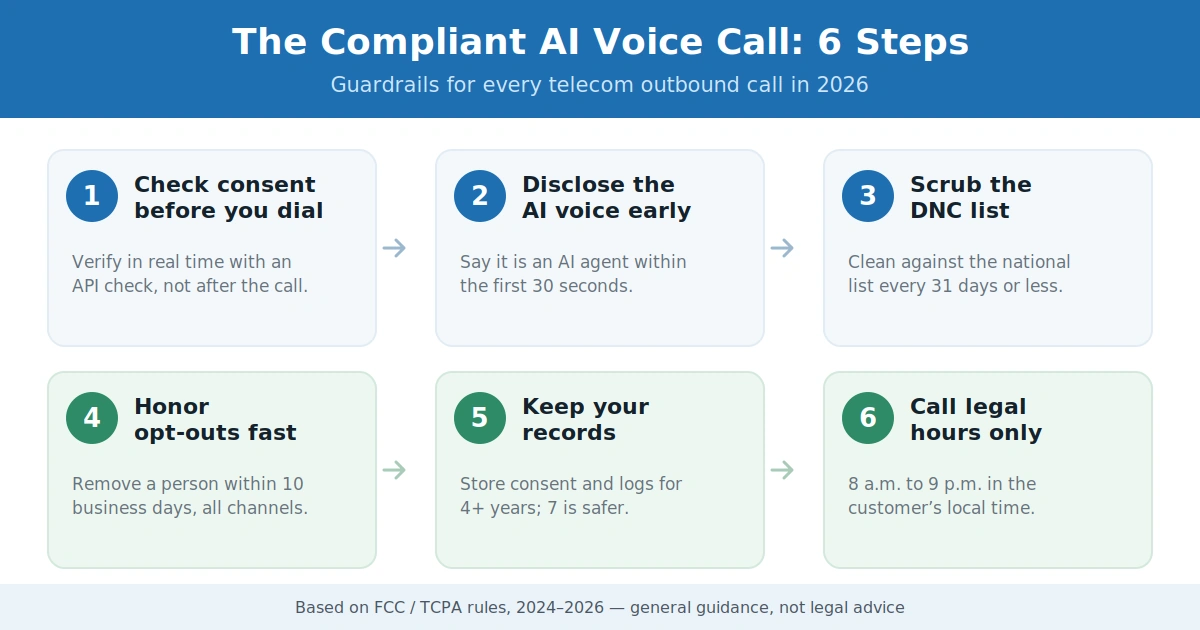 Six key compliance steps telecom outbound teams can use when deploying AI voice calls.
- Check consent before you dial. Verify consent in real time, not after the fact. Use an API check against your records.
- Disclose the AI voice early. Say it is an AI agent within the first 30 seconds. This builds trust and meets new state rules.
- Scrub the Do Not Call list. Clean your lists against the national DNC list at least every 31 days. Real-time checks are better.
- Honor opt-outs fast. Remove a person within 10 business days, across every channel they use.
- Keep your records. Store consent and call logs for at least four years. Seven years is safer.
- Call only in legal hours. Stick to 8 a.m. to 9 p.m. in the customer’s local time.
None of these steps are hard on their own. But the challenge is doing them perfectly, at scale, on every single call. So that is where many in-house teams slip. For example, a missed opt-out or an old consent record can trigger a claim. And with AI voice, one flaw repeats across thousands of calls.
Why process beats panic?
Some teams react to all this by pulling back on AI voice. However, that is an overcorrection. AI voice is still a powerful, legal tool. So the rules do not ban it. Instead, they just demand discipline around it.
So the goal is not to fear the tech. Rather, the goal is to wrap it in a strong process. Think of consent checks, disclosures, and clean records as guardrails. Then, with them in place, you keep the speed and savings of AI voice. And you simply remove the legal landmines.
Meanwhile, the teams that win here treat compliance as a system, not a scramble. So they build consent and suppression into the dialing flow. They log everything. And they review their RMD status on a set schedule. In short, they make the safe path the default path.
Keep your AI voice outbound fast and compliant.
AI voice can power your telecom outbound without putting your license at risk. But that only works with the right process behind every call. At Sequential Tech, we help telecom sales, retention, and collections teams run outbound programs that are both fast and compliant. Our agents and AI voice workflows build in consent checks, AI disclosures, DNC scrubbing, and clean record-keeping from the start. So you get the efficiency of AI voice with the guardrails that keep the FCC happy.
If your outbound program leans on AI voice, let’s pressure-test it together – book a free consultation, and turn compliance from a worry into a built-in strength.
Note: This article is general educational information, not legal advice. Confirm your program with qualified TCPA counsel.