
A practical guide for telecom CX leaders evaluating AI accent harmonization—how to boost clarity and CSAT while protecting agent identity, trust, and QA visibility.
AI accent harmonization is spreading fast across telecom contact centers. The pitch is simple: clearer calls, happier customers, and agents who feel understood. In 2026, that promise is real. Adoption and results are strong. Still, the tool sits close to something sensitive — a person’s voice. So before you deploy AI accent harmonization for telecom, the smart move is to slow down and evaluate. Get it right, and you cut friction and lift CSAT. Get it wrong, and you risk agent trust and brand reputation. Here is what CX leaders should weigh first.
The Real Question Every Leader Must Ask
Accent harmonization should fix one specific problem: phonetic comprehension friction. In plain terms, that is when a caller cannot quite catch what an agent says. It should not become a way to erase who your agents are. That line matters. Cross it, and the costs pile up:
- Eroded agent identity if the tool flattens voices into one robotic standard.
- Lost customer trust if callers feel they are hearing something fake.
- Masked root causes if speech tools hide bad scripts or noisy hardware.
- Added latency if a heavy tool slows your call path.
- QA blind spots if coaches cannot hear the agent’s real speech.
- Lower morale if usage feels forced on the team.
Every risk above is avoidable. The key is a careful evaluation, not a rushed rollout.
Why the Stakes Are Higher in Telecom
Telecom raises the stakes. Contact centers here run global, blended teams across many accents. At the same time, the calls are high-stakes: billing disputes, activations, and outage support. One misheard account number or address can derail a call. Moreover, telecom volumes are massive, so small clarity gains scale fast. That is why AI accent harmonization in telecom contact centers gets so much attention. Still, higher stakes cut both ways. A bad rollout lands harder here. So the evaluation matters even more.
First, Get the Technology Right
Not all accent tools are the same. In fact, three very different technologies often share one label. So start by knowing what you are actually buying.
I. Know the Three Technology Types
| Aspect | Wholesale Voice Conversion | Accent Translation | True Accent Harmonization |
|---|---|---|---|
| What it does | Replaces the voice with a new one | Converts speech to a target accent | Micro-adjusts only problem phonemes |
| Agent’s identity | Lost | Largely changed | Preserved (tone and pitch kept) |
| Comprehension gain | High but impersonal | High | High and natural |
| Main risk | Feels fake; erases identity | Cultural homogenization | Minimal, if optional |
True accent harmonization is the narrow, respectful option. It adjusts only the sounds that block understanding. Meanwhile, it keeps the agent’s natural tone and pitch.
II. Isolate the Root Cause
Next, be honest about the real problem. Speech tools fix comprehension, not everything else. So do not use them to patch deeper issues. Check these first:
- Poor scripts or weak knowledge bases.
- Cheap headsets or noisy floors.
- Slow systems that stall agents.
If the root cause is operational, fix that first. Otherwise, harmonization just hides the symptom. A quick audit often reveals the real fix. Sometimes a better headset beats any AI.
III. Check Latency and Telephony Impact
Then look under the hood. A good tool is lightweight. It should add almost no delay. Modern systems run in real time, often under 200 milliseconds. Importantly, it should layer onto your existing CCaaS and SIP routing. It must not force a full infrastructure overhaul. If a vendor needs to rebuild your call path, treat that as a red flag. Ask for a clear latency figure in milliseconds. Also ask how the tool behaves on weak connections.
Then, Get the Governance Right
Technology is only half the decision. Trust and ethics decide whether the rollout lasts.
IV. Preserve Agent Identity
The goal is intelligibility, not assimilation. Agents should still sound like themselves. So choose a tool that sharpens clarity and keeps their character. A robotic, homogenized standard hurts both morale and authenticity. So ask agents how they feel about it. Their buy-in is the real test.
V. Make It Voluntary
Give agents control. Usage should be opt-in, with an easy on/off toggle. This protects morale and psychological safety. Notably, the data backs this up. When the tool is optional, about 97% of agents choose to keep it on. Choice builds trust; force breaks it.
VI. Keep QA Visibility
Finally, protect your quality program. Coaches need to hear the agent’s raw speech, not just the processed output. So keep a clear line of sight between both. That way, QA scoring and coaching stay accurate. Without it, you lose insight into real performance. So ask the vendor how coaches reach the raw audio. If they cannot show you, keep looking.
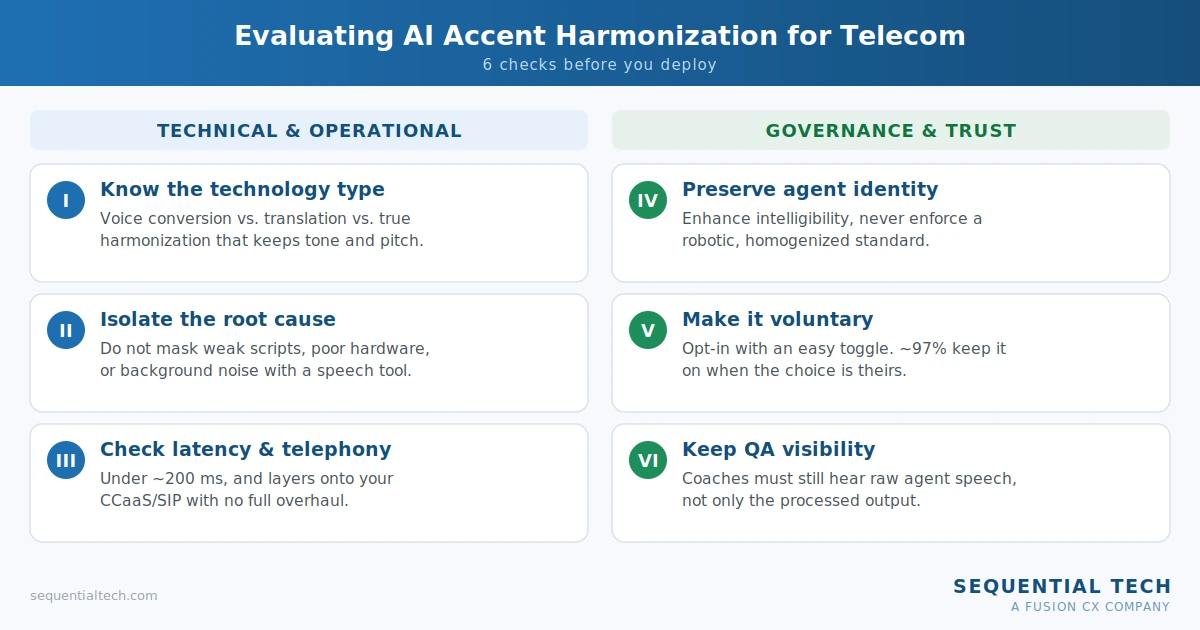 Six checks telecom CX leaders should complete before deploying AI accent harmonization.
What the 2025–2026 Data Shows
The business case is strong when the tool is used well. Recent data makes that clear:
- Adoption is high. When optional, roughly 97% of agents keep accent harmonization on. In one Manila rollout, first-day adoption reached 99.2%.
- Attrition falls. Frost & Sullivan reported a 36% drop in agent attrition. One deployment cut monthly attrition to 0.8%, far below the 5–10% norm.
- Clarity improves. In a 2025 study, 44% of agents rose one proficiency level in perceived English. Nearly half rose two or three levels.
- Latency stays low. Leading tools process speech in under 200 milliseconds.
- The category is scaling. Adoption has spread to more than 30,000 contact center agents worldwide.
Attrition alone is costly, at roughly $10,000 to $20,000 per agent replaced. So better retention pays for itself. That said, keep balance in mind. Some research suggests that exposure to varied accents can reduce bias over time. Therefore, harmonization should support understanding, not erase difference. Used with care, it lifts clarity while respecting the person behind the voice.
Run a Small Pilot First
You do not have to bet the whole floor. Instead, start with a small pilot. Pick one team, one queue, or one region. Then run the tool for a few weeks. This keeps risk low and learning high. Set clear rules before you start:
- Make it opt-in from day one.
- Measure a baseline first, then compare.
- Gather agent feedback every week.
- Keep raw-audio access for QA.
Because the pilot is small, you learn fast and cheaply. If the results hold, you scale with confidence. If they do not, you adjust before any wide rollout.
Metrics That Prove It Is Working
Pick your target metric before launch. Then track it closely. For most telecom teams, four numbers tell the story:
- AHT. Fewer clarification loops should shorten calls.
- CSAT. Clearer calls should lift customer scores.
- FCR. Better understanding should raise first-call resolution.
- Agent adoption. High opt-in use signals real value.
Also watch error rates on names, numbers, and addresses. In telecom, those small details matter most. If your chosen metric moves and adoption stays high, the tool is earning its place.
Red Flags in a Vendor Demo
A demo can hide as much as it shows. So watch for warning signs. Be cautious if you see any of these:
- The vendor cannot state latency in milliseconds.
- The tool replaces the voice instead of adjusting phonemes.
- There is no opt-out for agents.
- Coaches lose access to raw audio.
- The setup needs a full telephony rebuild.
- Results come with no baseline or method.
Each red flag points to risk. A strong vendor answers all six with ease.
What Good Looks Like
So how do you know it worked? A healthy rollout shows a few clear signs. First, agents keep the tool on by choice. Next, your target metric moves within weeks. Then, clarity complaints drop. Also, coaching stays sharp, because QA still hears raw speech. Finally, agents report less stress on calls. When you see all five, the tool has earned its place. If a sign is missing, revisit your setup. In short, good accent harmonization feels invisible. It simply makes calls clearer.
Your Pre-Deployment Checklist
Use this list to keep your evaluation honest. Before you sign, run this quick check:
- Does it target comprehension, not identity?
- Is it true harmonization, not full voice conversion?
- Have you ruled out script, hardware, and noise issues?
- Does it run at low latency on your current stack?
- Is it voluntary, with an easy opt-out?
- Can QA still hear raw agent speech?
Six yeses mean you are ready. Any single no means keep evaluating.
Ready to Make Every Telecom Conversation Clearer?
Sequential Tech helps telecom operators deploy AI accent harmonization without compromising agent identity or customer trust. Our Accent Harmonizer, powered by Sanas, improves speech clarity while fitting into your existing telephony and QA workflows. With up to 18% lower AHT, 22% higher CSAT, and 97% agent adoption, you can improve CX while keeping agents at the center.