

Every telecom operator knows the math. Winning a new subscriber costs five to seven times more than keeping one. Yet most providers still pour budget into acquisition while loyal customers slip away over a billing error or one bad support call. In 2026, that leak is too expensive to ignore. This guide explains how the telecom customer retention outsourcing process works, what it covers, and how to choose the right partner. As a result, you can plug the leak before your next quarterly report.
Why Retention Beats Acquisition in 2026
The numbers tell a clear story. Accenture estimates that US companies lose $136.8 billion every year to avoidable customer switching. Moreover, telecom sits near the bottom of the loyalty table, with an average retention rate of just 69% across the industry. The upside is equally dramatic. Bain & Company research shows a 5% lift in retention can raise profits by 25% to 95%. Additionally, Accenture found that 68% of customers leave because of poor service, not price. Therefore, better retention operations protect revenue more reliably than another discount campaign.The Pain Points Pushing Providers Toward a Retention Partner
Most operators explore customer churn management support after the same problems keep repeating. Do these sound familiar?- Churn that outruns acquisition. This is the biggest pain point. Annual telecom churn runs between 20% and 40% in many segments, so new sign-ups leave through the back door as fast as marketing brings them in.
- Saves that come too late. Teams only react after a cancellation request, when the decision is already made.
- Involuntary churn from failed payments. Expired cards and billing errors cause 20–40% of all churn, yet few operators chase these losses systematically.
- Overloaded in-house teams. Agents juggle support tickets and save calls, so neither gets done well.
- Loyalty programs nobody uses. Rewards exist on paper but never reach at-risk subscribers.
- No single owner of retention. Churn KPIs sit between marketing, billing, and support, so accountability disappears.
What Telecom Customer Retention Outsourcing Covers
In simple terms, you hand your retention operations to a specialist telecom retention partner. However, this goes far beyond a basic call center contract. A full program usually includes:- Save desk operations: trained agents who handle cancellation calls with tested offers and empathy.
- Win-back campaigns: structured outreach to recently churned subscribers across phone, SMS, and email.
- Churn analytics: predictive models that flag at-risk accounts before they call to cancel.
- Billing dispute resolution: fast fixes for the errors that trigger most cancellations.
- Telecom loyalty programs: design, promotion, and day-to-day management of rewards that subscribers actually redeem.
6 Ways a Telecom Retention Partner Cuts Churn
So how does outsourcing translate into lower churn? These six subscriber retention strategies do most of the heavy lifting.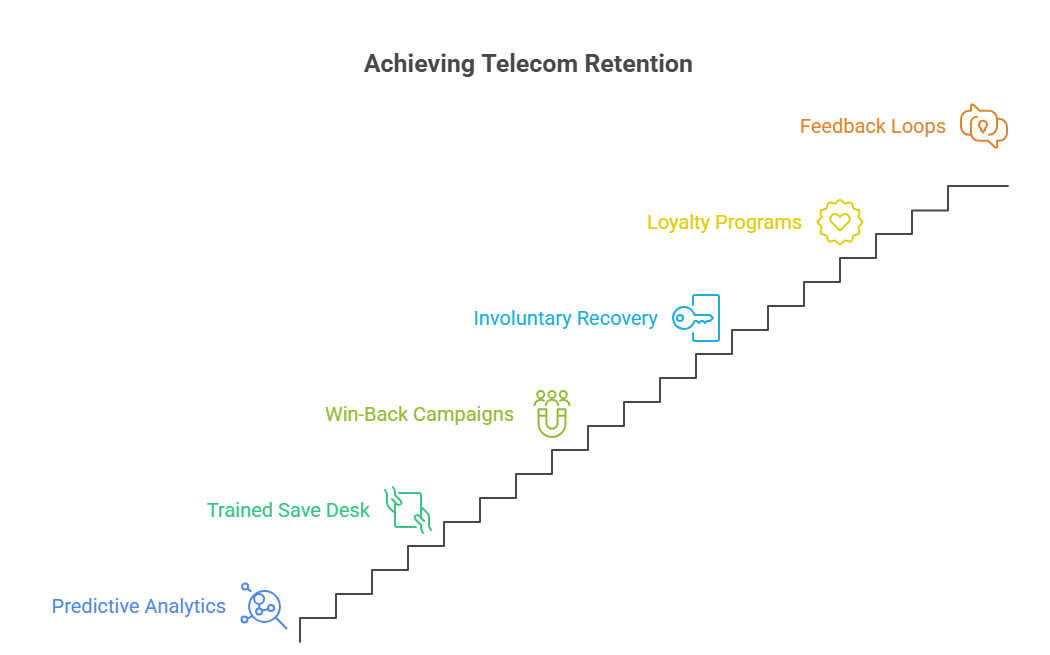
1. Predictive Churn Analytics
First, AI models score every account for churn risk using usage drops, complaint history, and payment patterns. Consequently, agents reach out weeks before a subscriber shops for a competitor. Companies that actively monitor churn this way cut attrition by an average of 26% within a year, according to Totango.2. A Trained Save Desk
Next, dedicated save specialists handle every cancellation request. They diagnose the real reason for leaving and match it with the right offer. In fact, a skilled save conversation rescues far more revenue than a blanket discount ever could.3. Structured Win-Back Campaigns
Churned subscribers are not lost forever. Instead, a retention partner runs timed win-back sequences with tailored offers. Former customers already know your network, so they convert at a fraction of normal acquisition cost.4. Involuntary Churn Recovery
Failed payments quietly drain your base. Therefore, partners run dunning workflows, card-update reminders, and friendly payment outreach. This recovers subscribers who never wanted to leave in the first place.5. Loyalty Program Management
Telecom loyalty programs only work when someone runs them daily. A partner promotes rewards to the right segments, tracks redemption, and links perks to tenure. As a result, subscribers build a reason to stay beyond price.6. Voice-of-Customer Feedback Loops
Finally, every save call and survey feeds insight back to you. Patterns in complaints reveal fixable root causes, such as a confusing bill format. Fix the cause, and the churn driver disappears for good.In-House vs. Outsourced Retention: A Quick Comparison
Should you build this capability or buy it? Use the table below to compare both paths honestly.| Factor | In-House Retention Team | Outsourced Retention Partner |
|---|---|---|
| Speed to launch | 6–12 months to hire, train, and equip | Trained telecom save desks live in weeks |
| Cost model | Fixed salaries, tools, and overhead | Flexible, often tied to saves and churn outcomes |
| Telecom expertise | Depends on internal hiring luck | Agents already skilled in saves and win-backs |
| Technology | Requires separate analytics investment | Predictive churn models and AI QA included |
| Scalability | Slow to flex during price hikes or outages | Ramps up fast when churn risk spikes |
| Coverage | Usually business hours, one language | 24/7, multilingual, multi-channel |
| Accountability | Retention split across departments | One partner owns churn KPIs end to end |
How to Choose the Right Retention Partner
Not every vendor can deliver these results. Above all, screen your shortlist against these checks:- Proven telecom save-desk results, with churn reduction numbers from real clients.
- Predictive analytics and AI quality monitoring built into the service.
- Pricing tied to outcomes, such as save rate or churn percentage.
- Security certifications, including PCI DSS and SOC 2.
- Real-time dashboards so you see saves, win-backs, and trends daily.
- 24/7 multilingual coverage that matches your subscriber base.
The Bottom Line
Churn is not a fixed cost of doing business. Rather, it is a process problem that specialist teams solve every day. Telecom customer retention outsourcing gives you trained save desks, predictive analytics, and managed loyalty programs without a year of internal hiring. Consequently, providers keep more of the subscribers they already paid to win. Remember, though, that the cheapest save is the churn that never happens. For that reason, explore how connecting onboarding to retention raises customer lifetime value from day one.KEEP THE SUBSCRIBERS YOU ALREADY EARNED
Sequential Tech’s telecom-trained retention and win-back specialists combine predictive churn analytics, skilled save desks, and loyalty program support to keep subscribers connected, helping operators cut churn by up to 22%. Talk to Our Retention Team →When ticket queues and escalations pile up, telecom help desk outsourcing is often the pragmatic fix.