

Comparison of MNO and MVNO capital investment and time to market for telecom growth. MVNO vs MNO shapes telecom growth through network control, costs, flexibility, scalability, and customer experience. Discover seven key differences and the strategies driving sustainable growth.
Two mobile brands can sell you the exact same 5G signal, yet run on completely different business models. One owns the towers, the spectrum, and billions in infrastructure. The other owns almost none of it, yet still wins customers through sharper pricing and smarter service. That contrast sits at the heart of the MVNO vs MNO debate. Moreover, the stakes keep rising as the global MVNO market races toward $102 billion in 2026. Both models chase the same prize, namely profitable and loyal subscribers. However, they pursue it on very different terms. So operators on both sides face one urgent question.
Which model truly drives growth, and where does it quietly stall?
Below are seven critical MVNO vs MNO differences that decide who scales and who stays stuck.
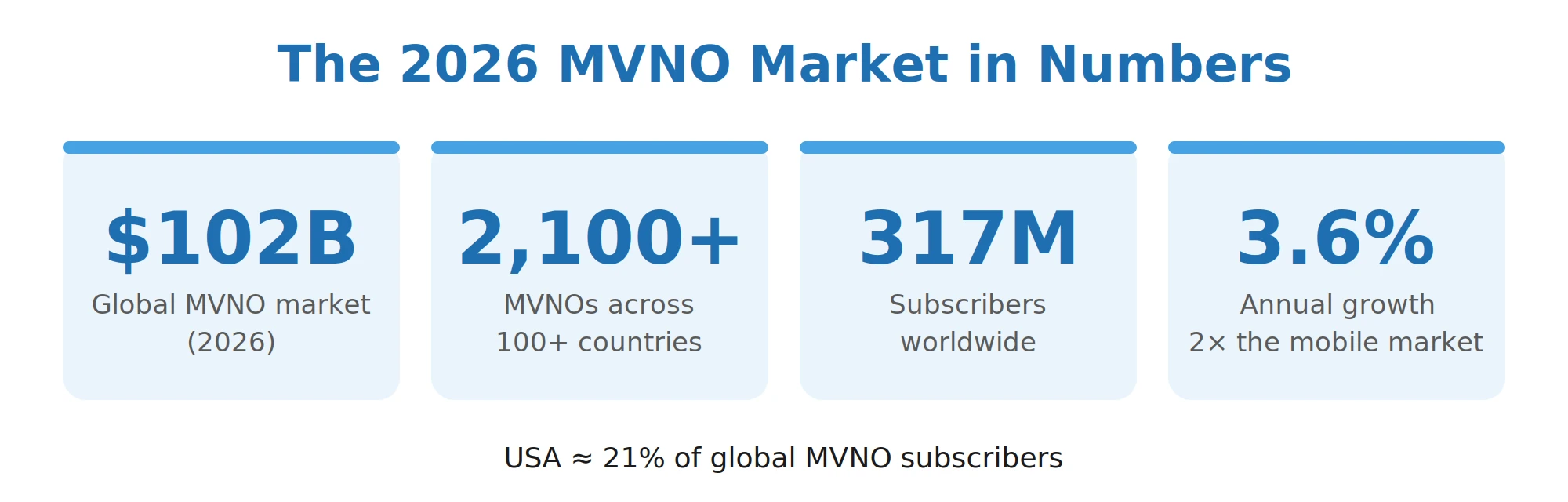 2026 MVNO market size, reach, subscribers, and growth at a glance.
MVNO vs MNO: The Core Definitions
First, let us clear up the basics. An MNO, or mobile network operator, owns the physical network. It holds the spectrum, runs the towers, and controls the core infrastructure. MNOs also manage billing, SIM provisioning, and regulatory compliance from end to end. Verizon, AT&T, and T-Mobile are classic examples of this model.
An MVNO, or mobile virtual network operator, works very differently. It leases network capacity from an MNO and then sells service under its own brand. As a result, the MVNO business model relies on partnership rather than heavy infrastructure.
Today, more than 2,100 MVNOs operate across 100-plus countries, serving around 317 million subscribers. Notably, the USA accounts for roughly 21% of that global subscriber base. MVNOs also come in several forms. Light resellers simply rebrand a host plan, while full MVNOs run their own core systems and billing. Each form carries a different level of control, cost, and complexity. Therefore, the single label “MVNO” can describe very different businesses.
1. Network Ownership and Infrastructure
This is the foundation of every other difference. An MNO network operator owns the radio towers, the spectrum, and the core systems that carry every call and byte. In contrast, an MVNO owns none of that hardware. Instead, it rents wholesale access and focuses on branding, pricing, and support. Therefore, one model is asset-heavy, while the other stays lean and flexible. That single choice shapes cost, speed, and strategy for years.
For growth, this trade-off cuts both ways. MNOs gain durable control and a strong competitive moat. MVNOs, meanwhile, gain speed and very low overhead. In short, ownership defines not only how each operator runs, but also how fast it can grow.
2. Spectrum and Licensing Rights
Spectrum is the invisible fuel of mobile service, and it is expensive. MNOs must win licenses at government auctions, often for staggering sums. For example, the 2021 US C-band auction alone raised about $81 billion. On top of that, licensing involves years of regulatory approval and compliance. However, MVNOs skip this hurdle entirely. Because they lease access, they never bid for spectrum or manage licensing. Consequently, they enter the market far faster and with far less risk.
This gap shapes growth in a clear way. An MNO must recover its spectrum spend across millions of users. An MVNO, by contrast, turns that fixed cost into a simple wholesale fee. As a result, MVNOs can test new segments without betting the whole company.
3. Capital Investment and Cost Structure
The cost gap between the two models is enormous. Building nationwide 5G can cost an MNO between $10 billion and $30 billion. On top of that, MNOs carry ongoing maintenance, upgrades, and staffing. MVNOs, by comparison, run an asset-light model. They trade heavy capital spending for predictable operating costs. As a result, MVNOs can launch with a fraction of the budget. In turn, they often reach profitability faster and compete aggressively on price.
Still, the asset-light model carries a catch. Because margins are thinner, MVNOs must control operating costs tightly. Therefore, efficient support and smooth billing become essential to profit. Put simply, cost discipline is where MVNO growth is won or lost.
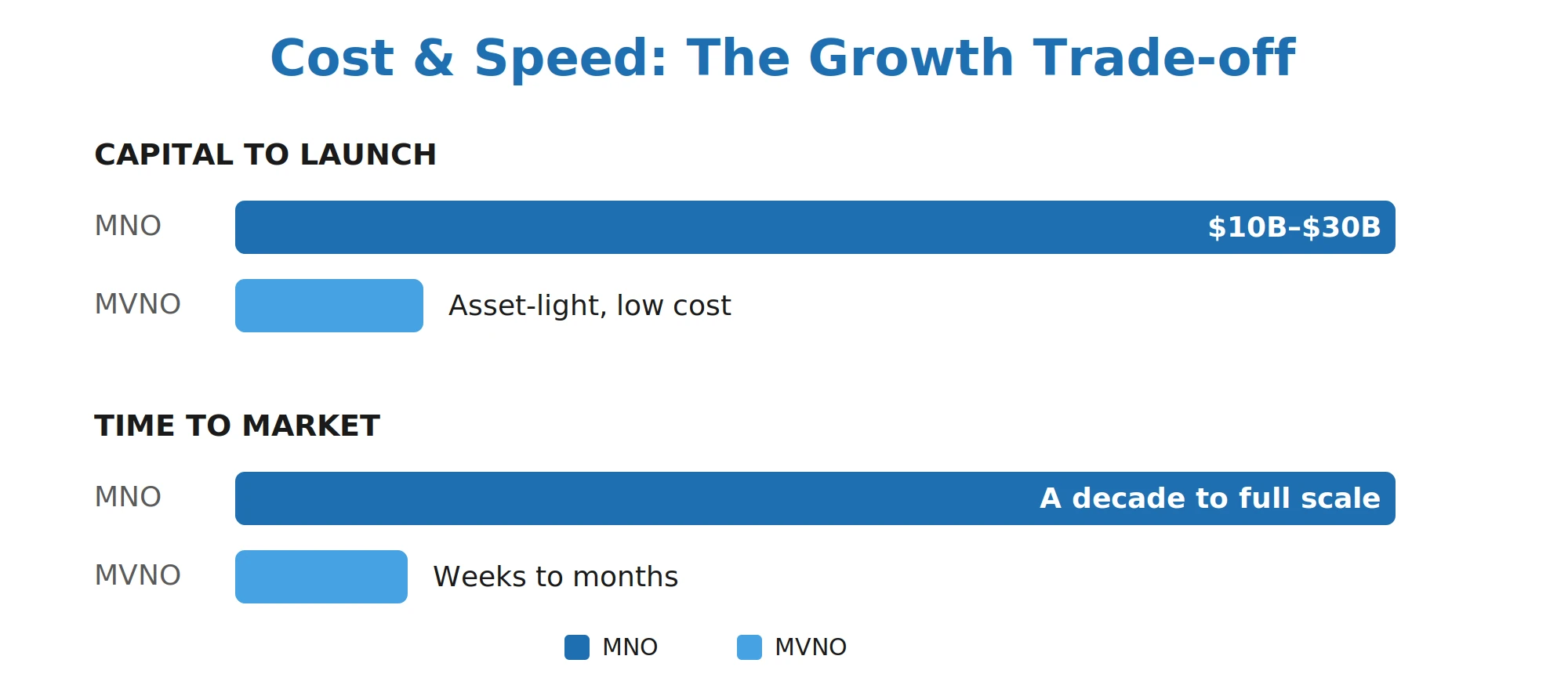 Comparison of MNO and MVNO capital investment and time to market for telecom growth.
4. Control Over Network Quality
Control is where MNOs hold a clear edge. Since they own the network, they manage coverage, speed, and reliability directly. MVNOs, though, depend on their host network for performance. During congestion, some host agreements even prioritize the MNO’s own customers first. Therefore, MVNOs must choose host partners carefully. After all, network quality directly shapes churn, reviews, and brand reputation. A weak host relationship can quietly cap an MVNO’s growth ceiling.
For MNOs, this control becomes a growth asset. They can guarantee quality and then market it with confidence. For MVNOs, the lesson runs the other way. Since they cannot promise raw network power, they must earn trust through service and clear communication.
5. Speed to Market and Flexibility
Here the advantage flips toward MVNOs. An MNO buildout can take a decade to reach full national scale. An MVNO, by contrast, can launch in weeks or months. Furthermore, MVNOs can pivot quickly, test new plans, and target fresh segments without touching the network. This agility explains why digital-first models keep rising. In fact, digital-only offerings now make up nearly 29% of active MVNOs worldwide. On top of that, roughly 42% of MVNOs now support eSIM, which makes instant onboarding even easier.
Speed, however, creates its own pressure. When customers sign up in minutes, they also expect instant help. So a fast launch demands an equally fast support engine behind it, because even small SIM fulfillment delays can stall early momentum. Otherwise, quick growth can quickly turn into quick churn.
6. Target Market and Brand Focus
The two models chase growth in different ways. MNOs serve the mass market and compete on coverage and raw network strength. MVNOs, meanwhile, thrive on focus. Many target specific niches, such as budget users, travelers, ethnic communities, youth audiences, or IoT devices. In fact, MVNO subscriptions are growing at 3.6% each year, more than double the wider mobile market. Clearly, sharp positioning fuels that momentum. For context, the US MVNO market alone could reach $49.7 billion by 2032. In such a crowded field, the top MVNO providers in the USA tend to win on focus and service.
This focus is a genuine growth engine. A tight niche lets an MVNO speak directly to one audience. As a result, marketing feels personal and retention tends to improve. Yet niche audiences also expect service that truly understands their needs.
7. Customer Experience and Support Ownership
This difference matters most for growth. Both models own the customer relationship, yet they compete on it very differently. Because MVNOs cannot win on network size, they must win on service. So fast onboarding, accurate billing, and responsive support become their real battleground. Likewise, MNOs face rising support costs as their subscriber bases grow larger. In response, many now lean on specialized MNO customer support. Therefore, strong MVNO operations and support increasingly decide who keeps customers and who loses them. Simply put, service quality has become the new growth engine.
The underlying math is simple. Winning a subscriber costs far more than keeping one. So every resolved issue protects revenue you already earned. In addition, happy customers refer others and lift lifetime value. Consequently, support is not really a cost center. Instead, it works as a growth center.
MVNO vs MNO at a Glance
The visual and table below sum up the key MVNO vs MNO differences in one clear view.
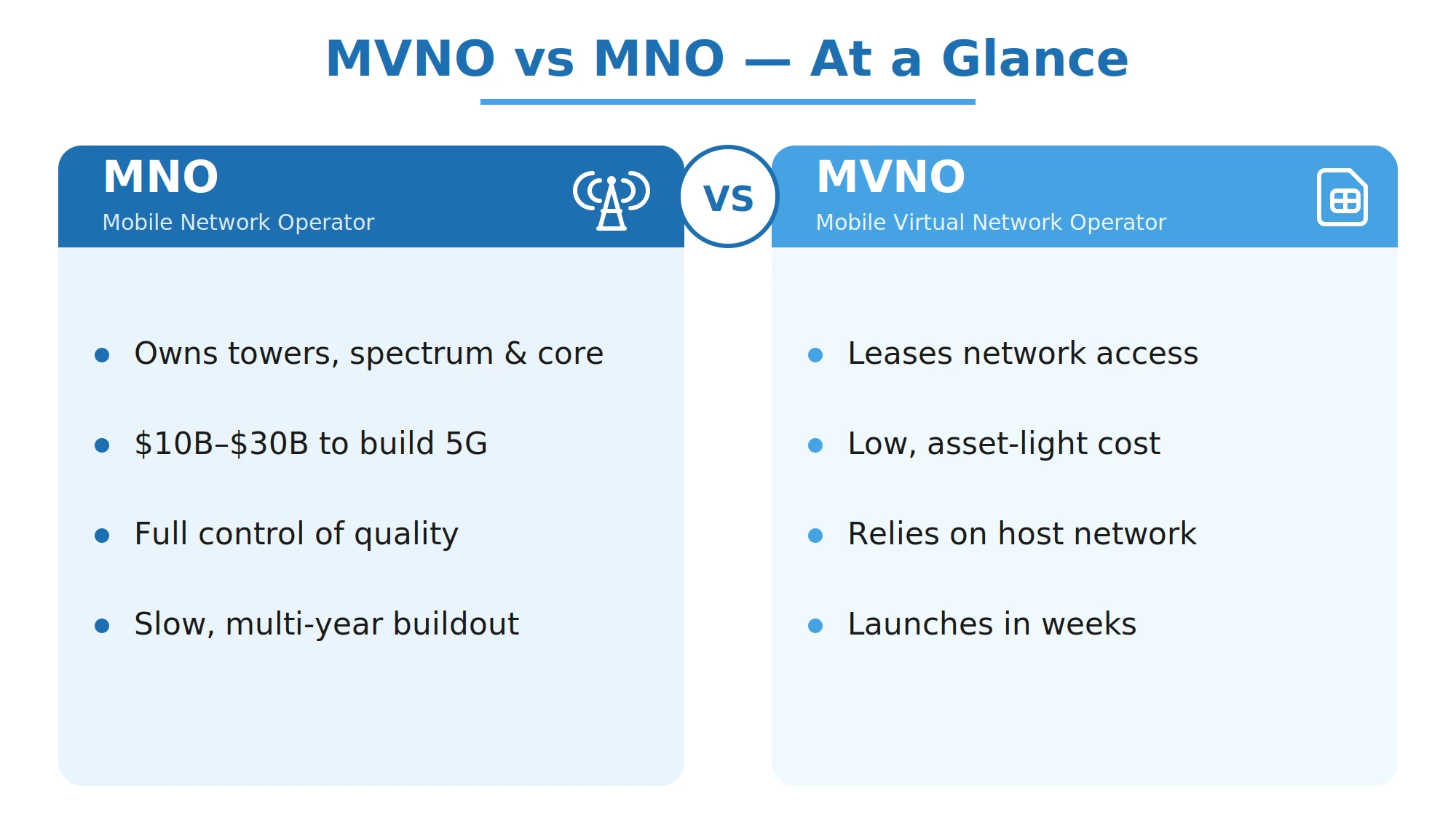 An at-a-glance comparison of MNO and MVNO network ownership, costs, control, and speed to market.
| Factor | MNO (Network Operator) | MVNO (Virtual Operator) |
|---|---|---|
| Network infrastructure | Owns towers, spectrum, and core | Leases access from an MNO |
| Spectrum license | Required, billions at auction | Not required |
| Capital investment | $10B to $30B for nationwide 5G | Low, mostly operating cost |
| Network control | Full control over quality | Depends on the host network |
| Speed to launch | Slow, multi-year buildout | Fast, often weeks to months |
| Core advantage | Coverage and network quality | Pricing, niche focus, service |
The Real Growth Pain Point You Cannot Ignore
Every difference above leads to one truth. Network ownership sets the model, but customer experience decides the growth. This is exactly where many operators quietly stall. Whether you own the towers or lease them, subscribers still judge you on service.
Here is what most often blocks telecom growth on both sides:
- High churn when onboarding or billing feels clunky.
- Rising support costs as subscriber volumes climb.
- Slow activations that frustrate new customers on day one.
- Weak retention when service issues go unresolved.
- Scaling gaps during launches, promotions, or seasonal spikes.
- Language barriers across diverse, multilingual markets.
Because these problems hide inside daily operations, they often go unnoticed until churn climbs. In fact, churn often starts at activation. For growing operators, the gap between a good network and a good experience is exactly where revenue leaks away. However, the right support partner can turn each weak point into a growth lever. In other words, execution beats infrastructure when it comes to keeping customers.
How Sequential Tech Helps
Sequential Tech delivers specialized MVNO operations and support built for telecom growth. Our teams handle customer care, technical support, activations & onboarding, billing support, and retention across the full subscriber journey. In addition, we pair skilled agents with AI-powered quality tools that lift first-call resolution and reduce churn. Whether you run as an MNO network operator or a lean MVNO, our telecom CX solutions help you scale faster and keep more customers.