How AI-powered network MTTR reduction depends on trained NOC agents who validate AI-generated diagnoses, run confirmation tests, coordinate carrier escalations, and communicate with affected subscribers.
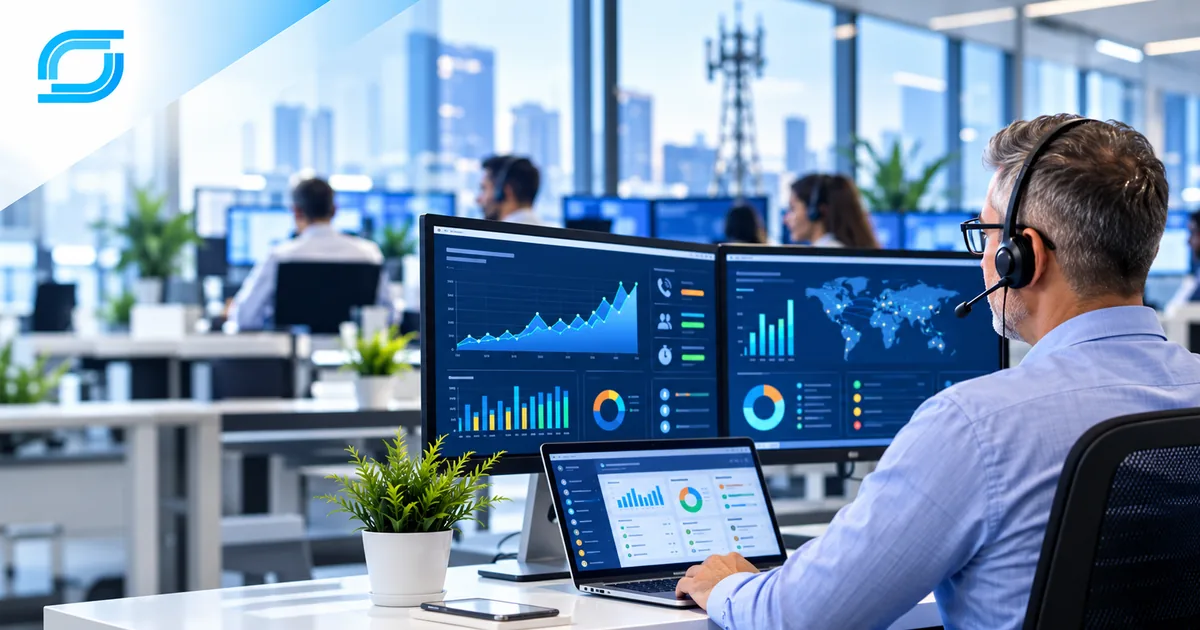
AI-powered fault isolation can now identify a probable root cause in minutes. However, an AI diagnosis alone does not resolve the issue. A trained NOC agent must step in to validate the finding. Additionally, the agent runs confirmation tests before escalating to the next level.
Furthermore, if the fault sits outside the provider’s network, the agent coordinates with upstream carriers. When physical repair is required, the agent dispatches field operations. Moreover, enterprise clients expect a human to explain what is happening and when service will be restored.
AI-powered network MTTR reduction is achieved through the combination of AI speed and human competency. The AI eliminates hours of manual investigation. Meanwhile, the NOC agent eliminates the remaining friction. This includes validating, escalating, coordinating, and communicating with all stakeholders.
Sequential Tech provides the trained NOC agents who work alongside AI diagnostic tools. As a result, they turn automated insights into confirmed resolution. Neither AI alone nor humans alone can achieve the speed that this combination delivers.
Faster restoration depends on the whole assurance chain — proactive fault prediction that prevents outages, cutting truck rolls with fast fiber triage, and protecting five-nines enterprise circuits.
The NOC Agent’s Role in AI-Assisted Fault Resolution
Agent Responsibilities at Each MTTR Phase
| MTTR Phase | What AI Does | What the NOC Agent Does | Why the Agent Is Essential |
|---|---|---|---|
| Detection | Flags anomaly in seconds | Reviews alert, confirms it is not a false positive, and categorizes severity | AI generates false positives that waste field resources if left unfiltered |
| Diagnosis | Correlates alarms and suggests root cause | Runs confirmation test on the affected circuit and validates the AI diagnosis | AI confidence varies, so agent verification prevents wrong escalation paths |
| Escalation | Recommends escalation path | Contacts the carrier with fault data, SLA urgency, and test results | Carriers require human contact with documented fault evidence |
| Coordination | Tracks ticket status | Follows up with the carrier, coordinates field dispatch, and manages parallel actions | Multi-party coordination requires judgment and real-time decision-making |
| Communication | Sends templated status updates | Calls enterprise client to explain impact, timeline, and actions taken | Enterprise clients expect human communication during critical incidents |
| Verification | Runs post-fix automated test | Confirms service is restored, contacts client for acceptance, and closes ticket | Human confirmation ensures no residual issues remain; client sign-off is required |
Training NOC Agents for AI-Assisted Operations
AI-powered network MTTR reduction requires NOC agents trained in a new operational model. Traditional NOC training teaches agents to investigate from scratch. In contrast, AI-assisted training teaches agents to validate AI conclusions. Additionally, agents learn to recognize when AI confidence is too low to trust.
Moreover, agents must know when to override the AI’s recommendation entirely. Sequential Tech’s NOC agents receive training on both the carrier’s network infrastructure and the specific AI diagnostic tools in use. Consequently, they work with the AI rather than around it.
This training approach produces faster resolution times. Therefore, carriers benefit from agents who add value at every stage of the incident lifecycle. As a result, MTTR drops significantly when trained agents and AI tools operate together.
Subscriber Communication During Incidents
Enterprise clients with SLA-governed circuits expect proactive human communication during any service-impacting incident. AI cannot deliver the empathetic, context-aware communication that enterprise account managers need. Therefore, Sequential Tech’s NOC agents follow enterprise communication protocols.
These protocols include initial notification within defined timeframes. Additionally, agents provide regular status updates throughout the incident. After resolution, agents deliver post-resolution follow-up with a root cause summary. Consequently, this communication layer transforms a technical resolution into a trust-building customer experience.
Why This Matters for Your Network Operations
Organizations that deploy AI without trained NOC agents often see minimal MTTR improvement. The AI identifies the problem, but nobody validates or acts on the diagnosis quickly enough. As a result, resolution times remain high despite significant technology investment.
However, when you combine AI diagnostic tools with Sequential Tech’s trained NOC agents, the results change dramatically. Detection time drops from minutes to seconds. Furthermore, escalation time shrinks because agents prepare complete fault packets. Overall, MTTR can decrease by 40–60% compared to manual-only operations.
STAFF YOUR NOC WITH AGENTS WHO MAKE AI WORK
Sequential Tech’s NOC agents validate AI diagnoses, coordinate escalations, and communicate with enterprise clients. They turn automated insight into confirmed resolution.