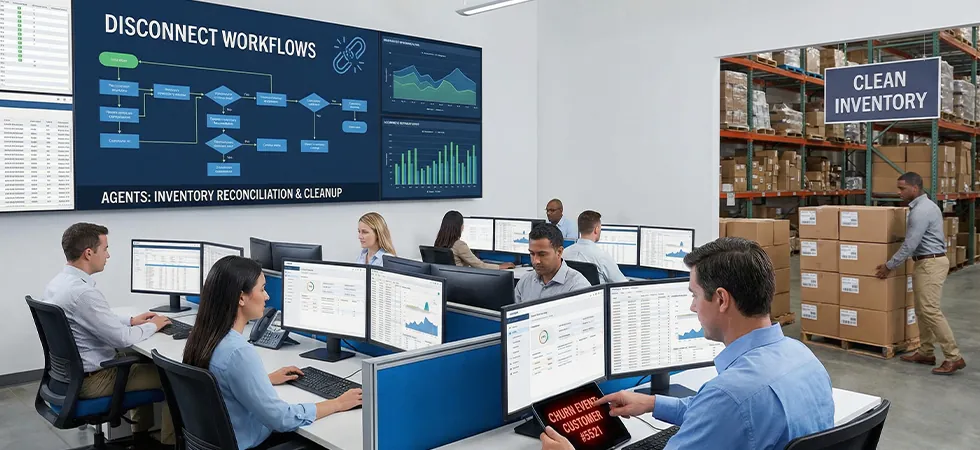
How automated telecom circuit disconnects still depend on trained agents who process disconnect orders, verify multi-system completion, investigate failures, and maintain the inventory accuracy that automation alone cannot guarantee.
Automated disconnect workflows handle the majority of post-churn circuit decommissioning efficiently. But 10–20% of disconnects encounter exceptions that automation cannot resolve: a system timeout prevents billing from updating, a provisioning platform rejects the disconnect command due to a dependency conflict, or a physical port release requires coordination with field operations that cannot be automated.
Each unresolved exception creates an inventory contamination event that compounds over time. Automated telecom circuit disconnects work best when trained agents manage the exceptions that automation generates. Sequential Tech provides disconnect processing agents who monitor automated workflows, investigate failed disconnects, and ensure that every churn event results in a completely clean inventory record across billing, provisioning, NMS, and physical plant systems.
A disconnect is not just a clean-up task — handled right, it becomes the disconnect call as a win-back opportunity.
Common Exceptions in Automated Disconnect Workflows
Five Failure Types That Require Agent Investigation and Resolution
Understanding why automation fails in specific scenarios is the foundation of effective exception management for automated telecom circuit disconnects.
| Exception Type | Why Automation Failed | Agent Investigation | Resolution Action |
|---|---|---|---|
| Billing system timeout | Database lock during batch processing prevented update | Agent retries during off-peak, verifies billing record updated | Manual billing record closure with timestamp |
| Provisioning dependency conflict | Circuit has an undocumented relationship to another active service | Agent traces dependency, contacts provisioning team to resolve | Dependency documented, disconnect reprocessed after resolution |
| NMS monitoring orphan | Monitoring profile not automatically removed with disconnect | Agent identifies orphaned monitoring, submits removal request | Monitoring profile removed, false alarm risk eliminated |
| Physical port release required | Port cannot be remotely released, requires field operation | Agent creates field dispatch ticket with specific port and location | Field tech releases port, agent confirms and closes record |
| Partial disconnect | Some systems updated, others not, resulting in mismatched records | Agent audits each system, identifies which did not complete | Agent manually completes updates in each failed system |
Daily Exception Queue Management for Disconnect Agents
Zero-Backlog Processing as the Operational Standard
Automated telecom circuit disconnects generate a daily exception queue that disconnect processing agents work through systematically. At a carrier processing 10,000 churn disconnects per month with a 15% exception rate, the queue contains approximately 1,500 exception records monthly, 75 per business day. Each exception requires investigation, resolution, and documentation.
Without agents processing this queue, the exceptions accumulate and inventory contamination grows at a rate of 1,500 discrepancies per month. Sequential Tech’s disconnect processing agents are trained on the carrier’s specific systems and exception patterns. They work the queue daily, resolving straightforward exceptions in minutes and escalating complex cases with complete context. The target: every failed disconnect investigated and resolved within 48 hours.
“Automation handles 85% of disconnects perfectly. The 15% that fail are where inventory contamination begins. The disconnect processing agent who clears the exception queue daily is the person who keeps the inventory clean. Without that agent, automation creates a growing mess.” — Circuit Lifecycle Management Report, 2026
Disconnects feed the broader inventory lifecycle — the ROI of network asset reclamation, circuit mapping that resolves database conflicts, and grooming inventory for growth.
Operational Standards for Disconnect Exception Management
Performance Benchmarks That Define Clean-Inventory Operations
- Exception resolution SLA: 100% of exceptions resolved within 48 business hours
- Zero-backlog standard: Exception queue cleared daily before new churn events are processed
- Multi-system verification: Every resolved exception confirmed clean across billing, NMS, provisioning, and physical plant
- Escalation protocol: Complex exceptions escalated within 4 hours with full investigation context documented
- Monthly contamination rate target: Less than 0.5% residual discrepancy rate across total active circuit inventory
KEEP YOUR INVENTORY CLEAN BY CLEARING EVERY DISCONNECT EXCEPTION
Sequential Tech’s disconnect processing agents monitor automated workflows, investigate failures, and resolve every exception within 48 hours; preventing the inventory contamination that automation alone creates.